Bathroom Color Schemes That Work
By the JDI Construction teamReviewed by Arthur Kulchitskiy, Project Consultant, and Denise Lacquement, Designer (bathroom specialist)Updated October 20266 min read
Build a bathroom color scheme from the things you cannot repaint: tile, the vanity top and the tub or shower base. Choose those first, then the vanity color, then one metal finish, and pick paint last to fit what is already chosen. Keep one undertone running through the room, give it one clear contrast, and test every sample in the bathroom's own light before you order.
A bathroom has less wall and more hard surface than any other room in the house. Tile, a counter, a tub or shower base, glass, metal and a mirror take up most of what you see, and paint fills in the gaps. That changes how you choose color: the scheme is set by materials that are expensive to change, and paint is the last and smallest decision. This page gives the order to choose in and the principles that hold a bathroom palette together.
Choose in the order things are hard to change
Start with what costs the most to replace and work toward what costs the least. That way every later choice is made against real samples rather than a memory of them.
- Tile. Floor tile, shower wall tile and any accent tile carry most of the color in the room. They are also the first thing ordered, because tile sets the schedule. If you love a particular tile, start there.
- The fixed whites. The tub, toilet, sink and shower base each have their own white. Gather them before you choose a white tile or paint, because two whites that almost match look like a mistake. See white bathrooms for how to line them up.
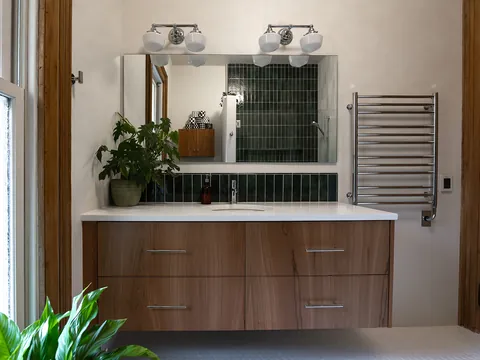
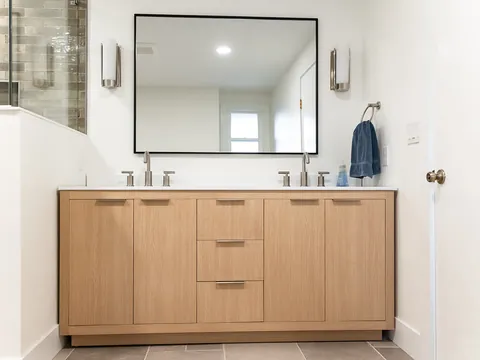
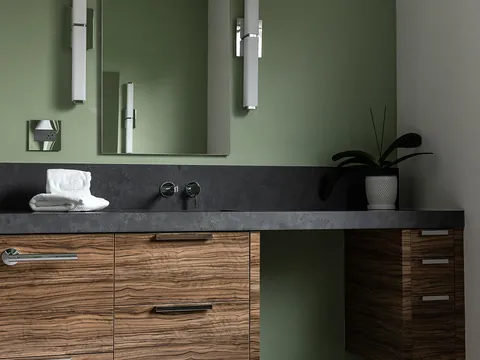
- Vanity and counter. The vanity is the largest piece of furniture in the room and often its strongest color. Painted, stained wood or a solid color, it should either echo the tile or contrast with it on purpose. Vanity colors and wood tones covers the options.
- One metal finish. Faucet, shower trim, towel bars and light fixtures read as a line of metal across the room. Pick the finish against the tile and vanity samples. See bathroom fixture finishes.
- Grout. Grout color changes how busy the tile looks more than most people expect. Decide it with the tile in hand; tile and grout color pairings explains the choice.
- Paint. Last, once everything above is chosen or sampled side by side.
The principles that hold a palette together
One undertone through the room
Most neutrals lean warm (toward yellow, red or tan) or cool (toward blue, green or gray). A bathroom feels calm when its tile, counter, vanity and paint lean the same way. A warm cream tile beside a blue-white counter makes each look dirty. Hold two samples side by side on a white sheet of paper and the lean becomes obvious.
One clear contrast
A room with no contrast at all can look unfinished. Decide where the contrast will be: a dark vanity against light tile, a dark floor under light walls, or black metal against white. One strong contrast reads as a design choice; three compete.
Proportion
Designers often use a rule of thumb that splits a room roughly into a dominant color, a secondary color and a small accent. It is a guideline, not a formula, but it is a useful check. In a bathroom the dominant color is usually the tile or the walls, the secondary is the vanity, and the accent is the metal or a small tiled feature.
Texture counts as color
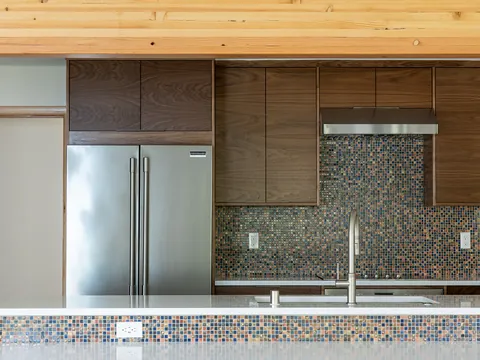
Matte and glossy versions of the same color look like two shades, and a handmade tile with an uneven glaze looks richer than a flat one in the same color. If a palette feels dull, vary texture before adding another color.
Light schemes and dark schemes
| Scheme | What it looks like | Works well when | Watch for |
|---|---|---|---|
| All light | Pale tile, white or pale vanity, light paint | The bathroom is small or has little daylight; you want it to feel open | Can look flat or clinical without wood, texture or warm metal |
| Light with a dark anchor | Light walls and shower, dark floor or dark vanity | Most bathrooms; the dark element grounds the room | Dark floors show dust, hair and dried water; pick a mid-dark rather than black if that bothers you |
| Mid-tone | Greens, blue-grays, greige or wood throughout | Primary baths and powder rooms with decent light | Needs good vanity lighting; mid-tones go muddy under dim light |
| Dark and enclosed | Dark walls or tile, sometimes a dark ceiling | Powder rooms and rooms you use briefly; a deliberate dramatic look | Shows soap residue and water spots; needs strong, well-placed light |
Reading LRV on a paint chip
Light reflectance value tells you how much light a color reflects. Sherwin-Williams describes the scale as running from 0 (absorbs all light) to 100 (reflects all light), and prints the LRV on the back of its color chips. The number is a fast way to compare how light or dark colors will feel in a bathroom with little daylight.
Here are a few manufacturer-published LRVs spread across the scale, to show what the numbers mean in practice. They are examples, not recommendations.
| Color | LRV (manufacturer) | Where on the scale |
|---|---|---|
| Sherwin-Williams Sea Salt SW 6204 | about 63 | A pale tinted color; reads clearly as a color, not a white |
| Sherwin-Williams Repose Gray SW 7015 | about 58 | A light neutral that reads mid-toned in a dim bathroom |
| Sherwin-Williams Evergreen Fog SW 9130 | about 30 | A medium color; the room will feel noticeably darker |
| Benjamin Moore Hale Navy HC-154 | 8.36 | A deep color; behaves like a dark wall, not a blue one, in low light |
The right column is our description of how colors in each range tend to behave, not a measurement. For whites and how our cloudy daylight shifts color, see bathroom colors for Pacific Northwest light.
Small bathrooms
A small bathroom does not have to be white, but it rewards a few habits:
- Fewer breaks. Carrying the floor tile up the shower wall, or using one wall color and one tile color, makes the room read as one space instead of several small ones.
- Let the glass disappear. A clear glass panel instead of a curtain keeps the tile visible to the back wall, so the room looks as deep as it is.
- Put color where the eye lands. A colored vanity or a tiled niche gives a small room personality without closing it in.
- Light the face, not just the ceiling. Color depends on light, and a single ceiling fixture leaves the walls in shadow. See bathroom lighting.
The layout ideas that actually gain space are in small bathroom ideas.
How to test a scheme before you commit
- Collect a real piece of every material: a tile, a vanity door or finish sample, a counter sample, a metal finish chip and two or three paint boards.
- Lay them out in the bathroom itself, in the positions they will occupy: floor tile on the floor, wall tile upright.
- Look in the morning, at midday and at night with the lights on. Bathrooms are often used before sunrise in winter, so the night view counts.
- Take away one item at a time. If the scheme falls apart when one piece leaves, that piece is carrying the room; make sure you love it.
Seeing schemes in real rooms
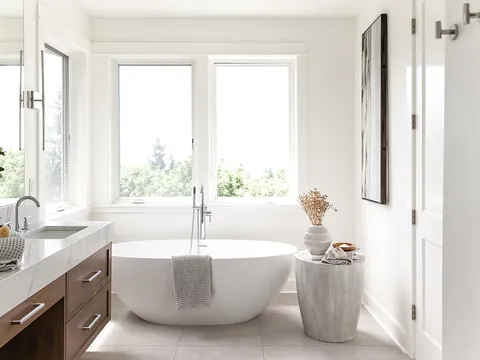
Photographs of finished bathrooms are useful for deciding what you like, as long as you choose the final colors from physical samples. You can browse bathrooms our team has completed around Vancouver and Portland on our bathroom projects page. When you are ready to put your own palette together, JDI's designer reviews tile, vanity, metal and paint samples with you as part of the design process, and our Vancouver bathroom remodeling page explains how a project starts.
Common questions
How many colors should a bathroom have?
Most bathrooms that feel settled use one main color family, one contrast and one metal, with white or a near-white counting as neutral. A small bathroom has so little wall that every extra color competes with the tile. If you want a bold color, give it one surface, such as the vanity or one tiled wall, rather than several.
Can I paint the bathroom a dark color if it has no window?
Yes, as long as you accept that the room will feel enclosed and you light it well. Dark paint in a windowless bath reads close to black under weak lighting, so plan good vanity lighting and keep the ceiling and the tile light. The paint sheen matters more than the color for moisture, so use a sheen suited to bathrooms.
Should the bathroom match the rest of the house?
It should relate to the rooms you see it from, usually the hallway or the primary bedroom, but it does not need to match. A shared undertone or repeating the trim color is enough to make the house feel connected while the bathroom has its own character.
Do I need to pick paint before the remodel starts?
No. Paint goes on near the end and is the easiest thing to change, so it should be chosen last, once the tile and vanity are installed or at least sampled side by side. What you must decide early are the tile, the vanity and the fixture finish, because those are ordered weeks ahead.
- Sherwin-Williams: Light reflectance value (LRV) explained
- Sherwin-Williams: Sea Salt SW 6204 (LRV 63.233)
- Sherwin-Williams: Repose Gray SW 7015 (LRV 58.22)
- Sherwin-Williams: Evergreen Fog SW 9130 (LRV 30.402)
- Benjamin Moore: Hale Navy HC-154 (LRV 8.36)
- Sherwin-Williams: Paint sheen guide
Checked October 2026. Rules, fees and programs change; confirm the current requirement with the agency before you rely on it.
Keep going
- Exploring · Color and style guidesWhite Bathrooms: Choosing the Right WhiteHow to choose whites for a bathroom: warm and cool undertones, matching fixture, tile, grout and paint whites, LRV, and keeping white from feeling clinical.
- Exploring · Color and style guidesVanity Colors and Wood TonesChoosing a bathroom vanity color: painted vs stained finishes, walnut and white oak, green and blue vanities, and coordinating the vanity with floor and tile.
- Exploring · Color and style guidesTile and Grout Color PairingsChoosing grout color for bathroom tile: matching vs contrasting grout, colored and handmade tile, floors vs walls, and keeping light grout clean.
- Exploring · Color and style guidesBathroom Fixture Finishes: Chrome, Nickel, Brass and BlackChrome, nickel, brass, bronze and matte black bathroom finishes compared: water spots, cleaning, mixing metals and matching across product lines.
- JDI ConstructionBathroom remodeling in Vancouver, WAOur bathroom remodeling service, recent projects and what to expect.
- JDI ConstructionBathroom projectsBefore-and-after bathrooms we have completed around Vancouver and Portland.