Bathroom Colors for Pacific Northwest Light
By the JDI Construction teamReviewed by Arthur Kulchitskiy, Project Consultant, and Denise Lacquement, Designer (bathroom specialist)Updated October 20265 min read
Vancouver bathrooms spend much of the year in cool, soft, cloud-filtered daylight, and many have small, frosted or no windows at all. In that light, cool grays and blue-whites turn colder and pale colors read darker than the chip. Choose colors with a little warmth, check LRV, plan warm vanity lighting, and judge samples under your own bulbs at night as well as by day.
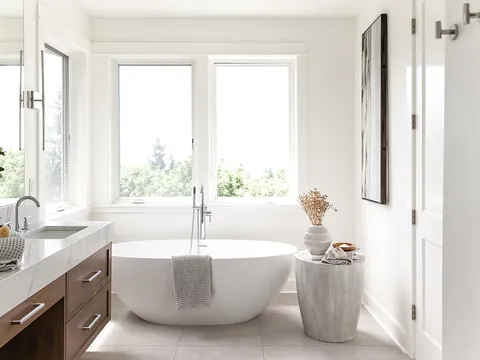
Bathrooms get the worst light in most houses. Windows are small, set high or filled with frosted glass for privacy, and plenty of hall baths and powder rooms have no window at all. Add the cloud cover of a Vancouver winter and a color that looked crisp on a sunny chip can look gray, flat or cold on your wall. This page is about choosing bathroom colors for the light you actually have.
Three kinds of bathroom light
Before you choose a color, work out which of these your bathroom has, because each one needs a different approach.
| Bathroom light | What it does to color | How to choose |
|---|---|---|
| Clear window, south or west facing | Warm, bright light for part of the day; colors swing between bright and gray as the weather changes | Most colors work; test on a gray day so you are not surprised in winter |
| Clear window, north or east facing | Cool, even light; colors pull toward blue-gray, especially pale grays and whites | Lean toward colors with some warmth; avoid whites and grays with a blue or violet cast |
| Small or frosted window | Soft, diffuse light that fades quickly away from the window; the far wall sits in shadow | Expect colors to read a step darker than the chip; judge samples on the darkest wall |
| No window | Electric light only; color depends entirely on the bulbs | Choose the lighting first, then test colors under it; daylight testing is irrelevant |
Trees and nearby walls matter too. A window that looks onto tall evergreens or a neighbor's painted siding takes on some of that color. Test samples next to the actual window, not in the hallway.
What overcast light does
Cloud scatters sunlight. The light that reaches your window is softer, cooler and dimmer than direct sun. Pale colors lose brightness, mid-tones go muddy, cool undertones become more obvious, and shadows almost disappear. In a bathroom, where much of the surface is glossy tile and glass, the soft light also shows water spots and streaks less than direct sun does, which is a small consolation.
The practical rule is to choose for the gray day. A color that looks right in dull winter light will also look right in July. The reverse is often not true. Our kitchen guide covers how daylight shifts color through the seasons in more depth on kitchen colors for Pacific Northwest light; this page stays with the issues that are particular to bathrooms.
Bulbs decide the color for half the year
From late fall to early spring, many people shower and get ready in the dark. The bathroom you see most of the winter is the one your light fixtures produce. Two things about a bulb change how colors look:
- Color temperature. Measured in kelvin and printed on the package. Lower numbers look warmer and more yellow; higher numbers look whiter and then bluer. Warm-white bulbs put back some of the warmth that overcast daylight lacks. Cool-white bulbs in a north-facing bath make the same cold effect at night.
- Color rendering. How faithfully the light shows colors, including skin tones. It matters at the mirror more than anywhere else in the house.
Use one color temperature throughout the bathroom. A warm vanity light with a cool ceiling fixture makes one wall look like two colors. The specifics of vanity, shower and ceiling lighting are on bathroom lighting.
Using LRV in a dim bathroom
LRV (light reflectance value) runs from 0, which absorbs all light, to 100, which reflects all light, according to Sherwin-Williams, which prints the number on each chip. It is a good way to see how light a color will feel, but it only describes the light that reaches the wall. In a small bathroom with one frosted window, even a very high LRV white sits partly in shadow.
| Color | LRV (manufacturer) | What to expect in a dim bathroom |
|---|---|---|
| Benjamin Moore Chantilly Lace OC-65 | 90.04 | Stays white near the light, but reads as pale gray on the shaded wall |
| Benjamin Moore Pale Oak OC-20 | 68.64 | Reads clearly as a soft greige, darker than the small chip suggests |
| Sherwin-Williams Evergreen Fog SW 9130 | about 30 | A medium color; makes the room feel enclosed unless it is well lit |
| Sherwin-Williams Naval SW 6244 | about 4.5 | Behaves as a dark wall; the blue shows only under strong light |
The right column is our expectation from how colors behave in low light, not a measurement. These colors are examples to calibrate your eye, not recommendations. For choosing among whites specifically, see white bathrooms.
Dark colors can work in dark rooms
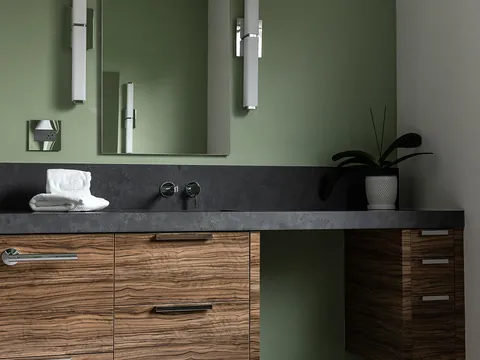
It is tempting to fight a dark bathroom with the palest possible paint. Sometimes the better move is the opposite. A powder room with no window can carry a deep green or navy well, because there is no daylight to compare it against and the room is used briefly. What dark colors need is light: a good vanity fixture at face height, a light-colored counter or tile to bounce it, and a ceiling kept pale. Where a room is used daily and has a little daylight, a mid-tone or warm light color is usually easier to live with.
How to test in a bathroom
- Paint large boards, not the wall. Two coats on a board at least the size of a sheet of paper. A patch on the existing wall is judged against the old color around it.
- Hold samples where they will be. Behind the vanity mirror, on the wall opposite the window and beside the shower, where the wall meets the tile.
- Put the tile and vanity sample beside the paint. Paint is chosen to suit them, not the other way round.
- Look at three times: on a cloudy morning, in the afternoon and at night with the bathroom lights on. In a windowless room, only the night test counts.
- Check yourself in the mirror. Wall color reflects onto your face. A strong green or yellow wall beside the mirror changes how skin looks under the vanity light.
Where to go next
Once you know how your light behaves, bathroom color schemes gives the order to choose tile, vanity, metal and paint. If you would rather work through samples with a designer in your own bathroom, JDI includes that in its design process; our Vancouver bathroom remodeling page explains how to start.
Common questions
What colors work in a bathroom with no window?
In a windowless bathroom, the light fixtures are the only light, so color depends entirely on the bulbs. Choose the lighting first, then test paint under it. Warm whites and colors with some warmth tend to look natural under warm-white bulbs; very cool grays can look lifeless. A deliberately dark color can also work, because there is no daylight to lose.
Does frosted or obscured window glass change colors?
It softens and spreads the light, which removes hard shadows, and it lets in less light than clear glass. Colors near the window look even and slightly duller than they would beside clear glass. Test samples on the wall opposite the window as well as beside it.
Why does my bathroom look different in the morning than in the evening?
In winter you may get ready before sunrise under electric light and come home after dark, so the bathroom spends little of its waking day in daylight. If the bulbs are a different color temperature from each other, or much cooler than the rest of the house, the room changes character again. Matching bulbs in one room solves most of this.
Is there a minimum LRV I should use in a dark bathroom?
There is no rule, and a high LRV will not rescue a room that has little light reaching it. LRV is a comparison tool: it tells you which of two colors will feel lighter. Use it to rule out colors that will feel darker than you want, then decide by undertone and by testing in the room.
Will a skylight or light tube fix a dark bathroom?
It adds daylight, which helps a great deal, but on a cloudy day that light is still cool and soft, so it brightens colors without warming them. Adding one means cutting into the roof and ceiling, so ask your contractor and the permit office what it involves before you plan around it.
- Sherwin-Williams: Light reflectance value (LRV) explained
- Benjamin Moore: Chantilly Lace OC-65 (LRV 90.04)
- Benjamin Moore: Pale Oak OC-20 (LRV 68.64)
- Sherwin-Williams: Evergreen Fog SW 9130 (LRV 30.402)
- Sherwin-Williams: Naval SW 6244 (LRV 4.458)
- EPA: A Brief Guide to Mold, Moisture and Your Home
Checked October 2026. Rules, fees and programs change; confirm the current requirement with the agency before you rely on it.
Keep going
- JDI ConstructionBathroom remodeling in Vancouver, WAOur bathroom remodeling service, recent projects and what to expect.
- Exploring · Color and style guidesWhite Bathrooms: Choosing the Right WhiteHow to choose whites for a bathroom: warm and cool undertones, matching fixture, tile, grout and paint whites, LRV, and keeping white from feeling clinical.
- Exploring · Color and style guidesVanity Colors and Wood TonesChoosing a bathroom vanity color: painted vs stained finishes, walnut and white oak, green and blue vanities, and coordinating the vanity with floor and tile.
- Exploring · Color and style guidesTile and Grout Color PairingsChoosing grout color for bathroom tile: matching vs contrasting grout, colored and handmade tile, floors vs walls, and keeping light grout clean.