Vanity Colors and Wood Tones
By the JDI Construction teamReviewed by Arthur Kulchitskiy, Project Consultant, and Denise Lacquement, Designer (bathroom specialist)Updated October 20265 min read
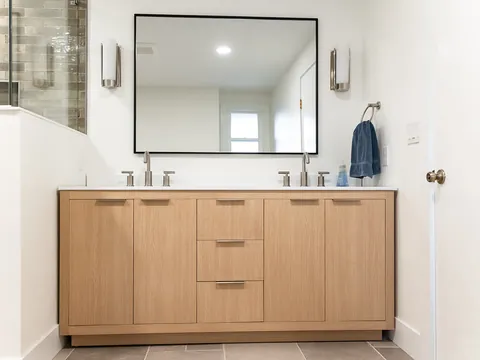
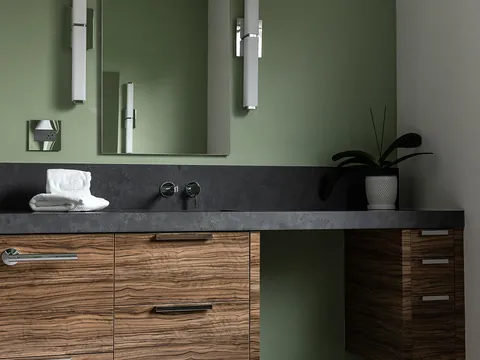
Stained wood such as white oak or walnut adds warmth and hides small wear; painted finishes give a solid color but show chips at edges and around the sink. A colored vanity, often green or blue, works best as the one strong color in an otherwise quiet room. Choose it against the floor and tile, and keep vanity and floor clearly different rather than nearly matching.
The vanity is the one piece of furniture in a bathroom, and usually the largest single block of color. It sits at eye level, beside the mirror, under the brightest light in the room. That makes it the easiest place to give a bathroom character and the most visible place to get a color wrong. This page covers finish type, wood tones, painted colors and how to coordinate the vanity with the floor and tile. Construction, sizes and materials are on bathroom vanities.
Painted or stained
| Painted | Stained or clear-finished wood | |
|---|---|---|
| Look | Solid, even color; grain may show faintly through on open-grain woods | Wood grain and color variation are part of the look |
| Color range | Any color, including whites, greens, blues and black | Limited to the wood plus stain; light to very dark |
| How wear shows | Chips at edges, toe kick and around the sink show as a different color | Small dents and scuffs blend into the grain |
| Touch-up | Easier to touch up in place if you keep the paint or a matched color | Harder; aged stain is difficult to match exactly |
| Change later | Can be repainted a new color | Can be painted over, but not easily returned to wood |
| Joints | On solid-wood doors, a hairline crack can appear at frame joints as wood moves with humidity | The same movement is less visible under stain |
Whichever you choose, the finish needs to be a cabinet-grade coating suited to a bathroom, applied to every face including the back and the cut edges around the sink. A bathroom vanity sees steam and splashes daily. The kitchen guide compares the two finishes in more depth on painted vs stained cabinets.
Wood tones
White oak
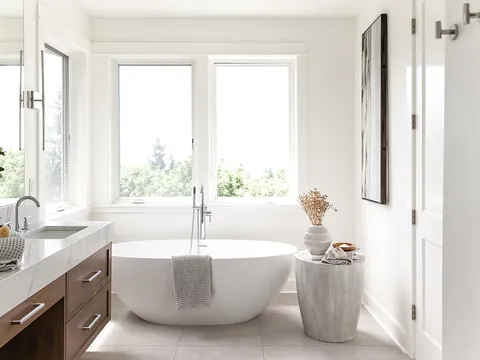
Light to mid, with a straw or tan color and a visible grain. Rift-sawn oak has straight, even lines; plain-sawn oak shows wide arches (often called cathedrals). White oak sits easily beside white and cream tile, greige walls, brass and black metal, and it warms a white bathroom without dominating it. You can see it in our three-bathroom remodel with white oak vanities in Battle Ground.
Walnut
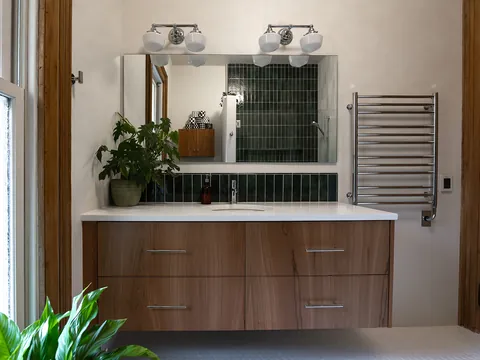
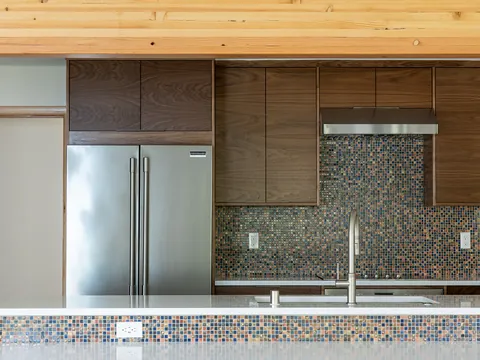
Dark chocolate brown with streaks of lighter wood. Walnut reads as rich and warm and pairs well with green, blue and cream tile, with brass, and with light stone or terrazzo-look floors. In a small, dim bathroom it can feel heavy, so give it a light counter and good vanity lighting. Our projects include a mid-century modern primary bath with a walnut vanity and vertical tile and a walnut and green tile primary bath with terrazzo.
Other species and stains
Maple and birch take paint and light stains evenly with little visible grain. Cherry darkens with light exposure over time, so a cherry sample will not match a cherry vanity a few years later. Stained gray or espresso finishes can look flat in overcast light; test them beside the floor in your own bathroom.
Painted vanity colors
A painted vanity is the simplest way to bring a strong color into a bathroom without committing a whole tiled wall to it. A few guidelines:
- Make it the one color. A green or navy vanity looks deliberate in a room of white or neutral tile. A colored vanity beside patterned colored tile competes.
- Mid and dark colors hide wear better than whites. A white vanity shows scuffs at the toe kick and drawer edges sooner.
- Check the color under the vanity light. The vanity is lit from above and in front by the mirror light; that is the light that matters.
These manufacturer-published LRVs show where some green and blue paint colors sit, as examples rather than recommendations. A lower LRV means a darker color.
| Color | LRV (manufacturer) | On a vanity |
|---|---|---|
| Sherwin-Williams Sea Salt SW 6204 | about 63 | A pale green-gray; a soft color that stays light in a small room |
| Sherwin-Williams Evergreen Fog SW 9130 | about 30 | A medium muted green; clearly a color without being dark |
| Benjamin Moore Hale Navy HC-154 | 8.36 | A deep navy; strong against white tile and warm metal |
| Sherwin-Williams Naval SW 6244 | about 4.5 | Very dark; reads almost black in dim light |
The right column is our description, not a measurement. Paint-store colors are formulated for walls; a cabinet finisher can match the color in a cabinet coating, and you should approve a finished sample door, not the chip.
Coordinating with the floor
The vanity sits directly on or just above the floor, so the two are always seen together.
- Contrast, do not nearly match. A wood vanity on a wood-look tile floor in almost the same tone looks like a failed match. Go clearly lighter or darker, or pick a floor that is not wood-toned at all.
- Undertones should agree. An orange-toned wood on a cool gray floor looks unrelated. Warm wood on warm stone or cream tile, cool painted colors on gray or white floors.
- A floating vanity changes the balance. A wall-hung vanity shows floor underneath it, so more floor is visible and the vanity reads lighter. A dark vanity on a light floor works especially well floating.
- Repeat once. Echoing the vanity wood in a shelf, mirror frame or linen cabinet ties the room together.
Coordinating with tile and metal
The wall tile behind the vanity, the counter and the faucet are all within a few inches of each other. Bring the tile, a counter sample and a metal finish chip to the vanity sample. Green vanities tend to look good with brass and warm whites, navy with both brass and polished nickel, walnut with brass or black, and white oak with almost anything. These are pairings that commonly work, not rules. Finishes are covered on bathroom fixture finishes, and the overall order of choices on bathroom color schemes.
Choosing with real samples
Ask for a finished sample door in the actual finish, not a printed swatch. Stand it upright against the floor sample in your bathroom, with the tile beside it, and look under your vanity lighting. JDI's bathroom designer, Denise Lacquement, guides vanity and finish selections as part of design. To see vanities in finished rooms, browse our bathroom projects.
Common questions
Is a painted or stained vanity better in a bathroom?
Both last when the finish is a factory or catalyzed cabinet coating and the box is built for moisture. A painted finish shows chips and wear at door edges and around the sink as a contrasting color; stained wood shows the same wear less because the wood color runs through. Paint is easier to touch up in place; stain is harder to match once it has aged.
Can I paint a vanity with wall paint from the store?
You can, but a vanity takes far more handling and water than a wall, and wall paint is not built for that. A named paint color can be matched in a cabinet-grade coating; ask the cabinet maker or finisher. A factory finish will usually outlast a brushed-on one in a bathroom.
Should the vanity match the kitchen cabinets?
It does not need to. Bathrooms are separate rooms and a different vanity color is often what gives a bathroom its own character. If the bathroom opens off the kitchen or a living space, repeating the wood species or the metal finish is enough to tie them together.
Will a wood vanity warp in a bathroom?
Solid wood and wood veneer move with humidity, which is why a well-ventilated bathroom and a sealed finish on all faces, including the inside of the sink cutout, matter. The bigger risks are standing water on the top edge and a slow leak under the sink. A working exhaust fan and a quick fix of any drip protect a wood vanity more than the species does.
- Sherwin-Williams: Evergreen Fog SW 9130 (LRV 30.402)
- Benjamin Moore: Hale Navy HC-154 (LRV 8.36)
- Sherwin-Williams: Naval SW 6244 (LRV 4.458)
- Sherwin-Williams: Sea Salt SW 6204 (LRV 63.233)
- EPA: A Brief Guide to Mold, Moisture and Your Home
Checked October 2026. Rules, fees and programs change; confirm the current requirement with the agency before you rely on it.
Keep going
- JDI ConstructionBathroom remodeling in Vancouver, WAOur bathroom remodeling service, recent projects and what to expect.
- JDI ConstructionBathroom projectsBefore-and-after bathrooms we have completed around Vancouver and Portland.
- Exploring · Color and style guidesTile and Grout Color PairingsChoosing grout color for bathroom tile: matching vs contrasting grout, colored and handmade tile, floors vs walls, and keeping light grout clean.
- Exploring · Color and style guidesBathroom Fixture Finishes: Chrome, Nickel, Brass and BlackChrome, nickel, brass, bronze and matte black bathroom finishes compared: water spots, cleaning, mixing metals and matching across product lines.