Bathroom Lighting: Vanity, Shower and Night Light Done Right
By the JDI Construction teamReviewed by Arthur Kulchitskiy, Project Consultant, and Denise Lacquement, Designer (bathroom specialist)Updated October 20266 min read
Light a bathroom in layers: general light for the room, task light at the mirror that reaches your face from the sides or front, a fixture over the shower, and a low night light. In Washington, fixtures in an enclosed shower or within 5 feet of a tub's waterline must be enclosed unless listed for that use, and new permanent fixtures must use high-efficacy sources such as LED.
Bathroom lighting has an unusual job list. It has to show your face accurately at 6 a.m., light a shower that is walled in glass or tile, be gentle at 2 a.m., and survive steam. One fixture in the middle of the ceiling cannot do all of that. Planning the light in layers, before the walls are closed, is what makes a bathroom feel finished.
Plan in layers
Designers think about four kinds of light in a bathroom. The National Kitchen and Bath Association's planning guidelines (a design recommendation, not code) call for task lighting at each functional area in addition to general lighting.
| Layer | What it does | Typical fixtures |
|---|---|---|
| General (ambient) | Lights the whole room evenly for cleaning and moving around | Ceiling fixture, recessed lights, fan-light |
| Task | Lights your face at the mirror and the area you are working in | Side sconces, vertical bars, a lighted mirror, a fixture above the mirror |
| Shower and tub | Lights a space that glass, tile walls or a curtain cut off from the rest of the room | Recessed or surface fixtures listed for the location |
| Night and accent | Low light for night trips, plus highlights for tile or a niche | Toe-kick strips, motion-sensing lights, lit niches |
A small powder room may combine general and task light at the mirror. A primary suite with a separate toilet room, a large shower and a double vanity may need every layer, often on separate switches.
Vanity lighting: light the face, not the top of the head
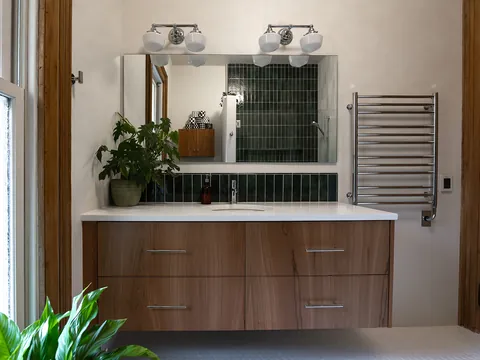
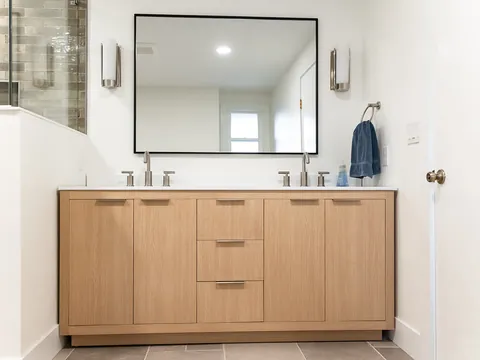
The most common bathroom lighting mistake is a single fixture high above the mirror. Light from directly overhead throws shadows under the eyes, nose and chin, exactly where you are trying to look. Light from the sides, roughly at face height, fills those shadows evenly. That is why makeup mirrors have lights around the edge.
Practical ways to get there:
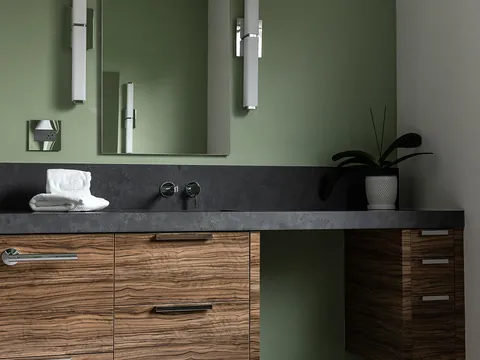
- Sconces on both sides of the mirror, mounted at about face height for the people who use the vanity. This is a designer rule of thumb, not a code requirement; mark the height on the wall with the household standing at the sink before the electrician sets boxes.
- A lighted mirror, which puts diffuse light right around your reflection. It needs a power feed planned behind it. See mirrors and medicine cabinets.
- A fixture above the mirror, when there is no room beside it. A wide, diffused fixture helps, and so does good ceiling light just in front of the vanity.
Coordinate the light positions with the mirror size, the medicine cabinet and the vanity width. On a double vanity, each sink should get its own pair of side lights or its own lighted mirror. Our page on vanity sizes and heights covers spacing.
Lights in and near the shower and tub
Shower lighting is where safety rules apply. Washington amends the national electrical code with a stricter rule: "All luminaires within an enclosed shower area or within five feet of the waterline of a bathtub must be enclosed, unless specifically listed for such use; these luminaires, with exposed metal parts that are grounded, must be ground fault circuit interrupter protected" (WAC 296-46B-410). The national electrical code also sets a clearance zone around and over tubs and showers that limits which fixtures may go there.
What that means when you shop:
- Read the listing. A fixture for inside a shower should be listed for that location (usually marked for wet or damp locations), not just "bathroom style."
- A chandelier over a freestanding tub is a common design wish. Whether it can go where you want depends on its listing and on that clearance zone; settle this with the electrician during design, not after the tub is set.
- Curbless showers change the map. The plumbing code treats the floor space in the same room as a curbless shower as a wet location, which affects which fixtures and devices can go where. See curbless showers.
The circuit, GFCI and receptacle rules for the room as a whole are on our bathroom electrical code page.
Color temperature and color rendering
Two numbers on a lamp or fixture box decide how a bathroom looks and how you look in it:
- Color temperature, in kelvins (K), describes how warm or cool white light appears. Lower numbers look warmer and more yellow; higher numbers look cooler and bluer. There is no single correct number, but every fixture in the room should match, or the room will look patchy.
- Color rendering index (CRI) describes how faithfully the light shows colors compared with a reference source, on a scale up to 100. Higher is truer. For makeup, shaving and judging skin tone, a high-CRI source at the mirror matters more than brightness.
Test before you commit. Look at a sample bulb with your actual tile, paint and vanity finish, at night, because many bathrooms get little daylight.
Dimming and night lighting
Bright, even task light is right for the morning; the same light is harsh at night. Two easy fixes:
- Dimmers on the general or vanity light. Use a dimmer the LED fixture maker lists as compatible, or the light may flicker or buzz.
- A separate low-level night light, such as a toe-kick strip under the vanity or a motion-sensing light, so a night trip never needs the main lights. This is especially useful for children and older adults.
Put the switches where you need them: at the door for general light, and within reach of the vanity for task light. A fan-light combination saves a ceiling opening but ties the light to the fan's position, which should be over or near the shower.
What Washington's energy code expects
When new lighting is part of a remodel, the 2021 Washington State Energy Code applies to it. "New lighting systems that are part of the alteration shall comply with Section R404.1," which requires permanently installed fixtures to contain only high-efficacy light sources. Replacing less than 10 percent of the fixtures in a space, without increasing lighting power, is exempt (WAC 51-11R-50300).
High-efficacy sources include LED and compact fluorescent, or any lamp of at least 65 lumens per watt, or a fixture of at least 45 lumens per watt (WAC 51-11R-20208). LED fixtures are the usual way to meet it. The energy code requires lighting controls such as dimmers or occupancy sensors for new fixtures in many rooms, but bathrooms are listed as an exception (WAC 51-11R-40410), so dimmers in a bathroom are your choice.
Permits for lighting work
Outside Vancouver city limits, L&I issues electrical permits. Its rules treat like-in-kind replacement of single-family residential light fixtures as Class A basic electrical work that needs no permit (WAC 296-46B-901). Inside the city, Vancouver issues and inspects its own electrical permits, so ask the city about a simple swap. Adding fixtures, moving boxes, adding switches or running new circuits is new wiring and needs a permit in both places. See electrical permits for a bathroom remodel.
Planning lighting with JDI
Lighting is part of JDI's bathroom planning ranges along with electrical work and fixtures, and the 3D design layout lets you see where sconces, the mirror and recessed lights sit before the walls are closed. Our bathroom designer, Denise Lacquement, coordinates fixture positions with the mirror, vanity and tile. To start, see our bathroom remodeling service in Vancouver.
Common questions
Is a single light above the mirror enough?
It lights the room but not your face well, because light from directly above casts shadows under the eyes, nose and chin. Light from both sides of the mirror, or a lighted mirror, fills those shadows. If wall space only allows one fixture above, choose a wide fixture and pair it with good ceiling light in front of the vanity.
Do I need a special light inside the shower?
Yes. Washington's electrical rules require fixtures inside an enclosed shower, or within 5 feet of a bathtub's waterline, to be enclosed unless they are specifically listed for that use, and those with exposed grounded metal parts must have GFCI protection. Recessed fixtures sold for shower use carry a wet or damp location listing on the box and the fixture.
Do I need a permit to change a bathroom light fixture?
Outside Vancouver city limits, L&I treats like-in-kind replacement of single-family residential light fixtures as basic work that needs no electrical permit. Inside Vancouver, the city issues its own electrical permits, so check with the city. Adding fixtures, switches or circuits is new wiring and needs a permit in either place.
Does Washington require dimmers in bathrooms?
No. Washington's residential energy code requires lighting controls such as dimmers or occupancy sensors for new fixtures in many rooms, but it lists bathrooms as an exception. Dimmers are still worth adding for night use, as long as the dimmer and the LED fixture are compatible.
- WAC 296-46B-410: luminaires in showers and near bathtubs (Washington electrical amendment)
- WAC 51-11R-50300: energy code for alterations (new lighting systems)
- WAC 51-11R-40410: high-efficacy lighting and controls (bathroom exception)
- WAC 51-11R-20208: definition of high-efficacy light sources
- WAC 296-46B-901: Class A basic electrical work
- L&I: City electrical permits and inspections
- NKBA: Bathroom Planning Guidelines with Access Standards
Checked October 2026. Rules, fees and programs change; confirm the current requirement with the agency before you rely on it.
Keep going
- JDI ConstructionBathroom remodeling in Vancouver, WAOur bathroom remodeling service, recent projects and what to expect.
- Exploring · Plan your bathroomBathroom Exhaust Fans and Moisture Control in the Pacific NorthwestHow to keep a Pacific Northwest bathroom dry: Washington's exhaust fan rules, sizing, sones, ducting outdoors, timers and humidity controls, and makeup air.
- Planning · Plan your bathroomShower Waterproofing Explained: Membranes, Pans and Why Tile Is Not WaterproofWhy tile and grout are not waterproof, how shower liners, sheet and liquid membranes and foam board systems work, flood tests, slope, and where leaks start.
- Planning · Plan your bathroomMoving a Toilet, Shower or Sink: What Plumbing Changes InvolveWhat it takes to move a toilet, shower or sink: drain sizes, venting, joist direction, slab vs crawl space, Vancouver permits and what drives the cost.