Bathroom Fixture Finishes: Chrome, Nickel, Brass and Black
By the JDI Construction teamReviewed by Arthur Kulchitskiy, Project Consultant, and Denise Lacquement, Designer (bathroom specialist)Updated October 20265 min read
Polished chrome shows water spots but wipes clean most easily. Brushed nickel hides spots and fingerprints well. Brass and bronze add warmth; unlacquered brass changes color on purpose. Matte black shows white mineral marks most. Pick one main finish for everything that carries water, and compare physical samples, because the same finish name differs between product lines.
The metal finish in a bathroom appears on more pieces than most people count: the faucet, shower head and trim, tub filler, drain, towel bars, robe hooks, toilet lever, cabinet pulls, light fixtures, mirror frame and the shower door hardware. Together they form a line of metal around the room, and they are touched and splashed every day. This page compares the finishes for looks and upkeep, explains how to mix them, and covers the problem of matching finishes from different makers. Faucet types and configurations are on bathroom faucets.
The finishes compared
| Finish | Look | Water spots and fingerprints | Cleaning | Relative cost |
|---|---|---|---|---|
| Polished chrome | Bright, mirror-like, slightly cool | Shows spots, but they wipe away easily | Easiest; tolerates routine cleaning well | Lower |
| Brushed or satin nickel | Soft, warm-gray metal with a fine grain | Hides spots and fingerprints well | Easy; avoid abrasive pads that change the grain | Mid |
| Polished nickel | Bright but warmer than chrome | Shows spots like chrome | Easy with a soft cloth | Mid to higher |
| Brushed or satin brass and gold tones | Warm yellow metal, soft sheen | Hides spots fairly well | Easy if coated; mild cleaners only | Mid to higher |
| Unlacquered brass | Starts bright, darkens and changes with use | Shows water marks as part of its aging | Polish if you want it bright, or let it age | Higher |
| Oil-rubbed or dark bronze | Dark brown, often with lighter highlights | Shows white mineral marks | Gentle; highlights can wear with handling | Mid |
| Matte black | Flat black, graphic | Shows white mineral marks and oily fingerprints most | Gentle; harsh cleaners and scrubbing can leave shiny patches | Mid |
| Stainless (usually accessories) | Gray metal, brushed | Hides spots fairly well | Easy | Mid |
Relative cost varies more by product line than by finish, so treat that column as a general pattern. How a finish is applied matters as much as its color. Some finishes are applied by physical vapor deposition (PVD), a process that bonds a thin metal coating to the part; others are plated, powder-coated or painted. Ask what process a finish uses and read the maker's warranty for what it says about finish wear.
Water spots and our water
When water evaporates from a fixture, the dissolved minerals stay behind as a faint white mark. How visible that mark is depends mostly on the finish color: white marks disappear on chrome once wiped and on brushed nickel almost entirely, and stand out on matte black and dark bronze.
In practice, any finish stays good-looking in a Vancouver bathroom if you wipe it dry now and then and clean it with mild soap and water or the cleaner the maker recommends. What damages finishes is abrasive pads, powdered cleansers and strong acid descalers left on the metal. Spotting on shower glass is a related problem with its own answers, covered on shower glass and doors.
Choosing a finish for the room
- White and light bathrooms. Any finish works. Chrome and polished nickel keep the room crisp; brass warms it; black adds a graphic outline. See white bathrooms.
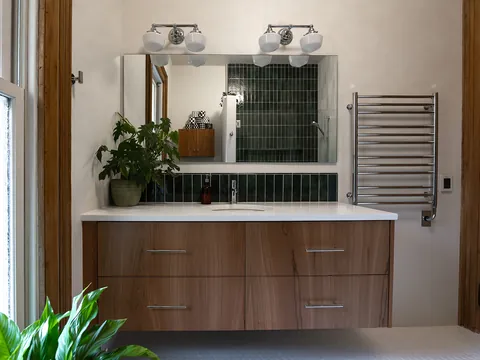
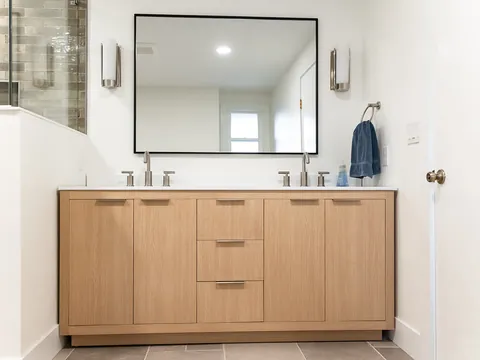
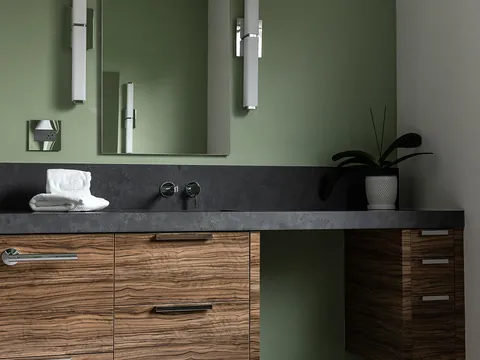
- Wood vanities. Brass and bronze echo warm wood; black suits walnut and white oak with a modern look; nickel sits comfortably with almost any wood.
- Green and blue tile or vanities. Warm metals such as brass are a common pairing; polished nickel suits navy and blue-gray.
- Busy hall and kids' baths. Brushed finishes hide fingerprints and spots between cleanings. Matte black in a heavily used shower needs more frequent wiping to stay even.
How the finish fits the rest of the palette is covered on bathroom color schemes.
Mixing metals
Mixed metals look deliberate when there is a clear rule behind them:
- Water-carrying fixtures in one finish. Faucet, shower head, shower trim, tub filler and the shower door hardware should match each other. They are seen together and a near-miss is obvious.
- A second finish on a different category. Light fixtures, mirror frames or cabinet pulls can be a second metal, applied consistently to that whole category.
- Two finishes, not four. A third metal in a small bathroom starts to look accidental.
- Contrast clearly. Brass with black, or nickel with brass, reads as a choice. Chrome with polished nickel, which are close but not the same, reads as a mismatch.
Small items such as drains, the toilet lever and the shower door hinges are easy to forget and are often only available in a few finishes. Check them before committing to an unusual finish.
Matching across product lines
Finish names are not standardized. One maker's brushed nickel may be warmer, darker or more textured than another's, and two makers' gold or brass finishes can differ noticeably in color. Even within one maker, finishes from different product lines or production years can vary slightly.
- Buy water-carrying pieces from one product line where you can: the faucet, shower valve trim and tub filler.
- Get physical samples. Finish chips or a small piece from each line, compared side by side under the bathroom lighting.
- Order everything together. Buying accessories a year later risks a slight color difference.
- Check that the shower valve trim matches the valve body you are installing. Trim and valve are often bought separately and must be compatible, which is one reason the valve is chosen before tile. See shower valves and controls.
What to check before you buy
- Is every piece you need available in the finish, including drains, levers, hinges and the tub filler?
- What finish process is used, and what does the warranty say about finish wear?
- What cleaners does the maker allow, and which void the finish warranty?
- Does the faucet meet Washington's flow limits? Washington's plumbing code limits residential lavatory faucets to 1.2 gpm at 60 psi (WAC 51-56-0400), lower than the WaterSense figure of 1.5 gpm. The finish does not affect this, but the faucet you fall in love with still has to comply.
The kitchen guide's hardware and fixture finishes page covers the same finishes for kitchen faucets and cabinet hardware. JDI's designer helps you compare finish samples during design, before anything is ordered; our Vancouver bathroom remodeling page explains how selections fit into a project.
Common questions
Which bathroom faucet finish shows water spots the least?
Brushed and satin finishes, such as brushed nickel or satin brass, hide water spots and fingerprints best because the surface already has a soft texture. Polished chrome shows spots but wipes clean in seconds. Matte black and other dark finishes show the white marks that dried water leaves most clearly.
Can I mix metal finishes in a bathroom?
Yes, if it looks deliberate. Keep everything that carries water (faucet, shower trim, tub filler) in one finish, and use a second finish for lighting, mirror frames or cabinet pulls. Two finishes is usually the comfortable limit in a bathroom.
Will my brushed nickel faucet match a brushed nickel shower valve from another maker?
Possibly not. Finish names are not standardized, so one maker's brushed nickel can be warmer, cooler, lighter or more textured than another's. Buying the faucet and shower trim from the same product line is the surest match; otherwise compare real samples side by side.
Does Vancouver water damage faucet finishes?
The City of Vancouver's 2025 water quality report gives hardness from 55 to 130 ppm across its system and does not classify the water as hard or soft. Any water with dissolved minerals leaves marks when it dries. Wiping fixtures dry and cleaning with the maker's recommended mild cleaner matters more for the finish than the water itself; abrasive pads and harsh cleaners do the real damage.
- City of Vancouver: 2025 Annual Water Quality Report (hardness 55 to 130 ppm)
- EPA WaterSense: Bathroom faucets
- Washington State Legislature: WAC 51-56-0400 (UPC as amended, fixture flow rates)
Checked October 2026. Rules, fees and programs change; confirm the current requirement with the agency before you rely on it.
Keep going
- JDI ConstructionBathroom remodeling in Vancouver, WAOur bathroom remodeling service, recent projects and what to expect.
- Exploring · Color and style guidesBathroom Styles: Modern, Traditional, Transitional, Mid-Century and SpaWhat defines modern, traditional, transitional, mid-century and spa bathrooms in tile, vanity, fixtures and lighting, and how to match a style to your home.
- Exploring · Color and style guidesCreating a Spa Bathroom at HomeHow to create a spa bathroom at home: calm materials, soft light, heated floors, a quiet fan, steam, a soaking tub, hidden storage and which features pay off.
- Exploring · Color and style guidesBathroom Color Schemes That WorkHow to build a bathroom color scheme from tile, vanity and metal finish, choose a light or dark palette, handle small rooms and read paint LRV.