Bathroom Faucets: Single-Hole, Widespread and Wall-Mount
By the JDI Construction teamReviewed by Arthur Kulchitskiy, Project Consultant, and Denise Lacquement, Designer (bathroom specialist)Updated October 20265 min read
Pick the faucet type to match the sink and holes: single-hole for simple modern vanities, widespread for a traditional look, wall-mount for vessel sinks. Check that the spout reaches the center of the bowl. Insist on a ceramic disc cartridge. Washington's plumbing code limits residential bathroom faucets to 1.2 gallons per minute at 60 psi, stricter than the WaterSense 1.5 gpm label.
A bathroom faucet is a small purchase that is hard to undo. Its holes are drilled into the countertop, its spout has to suit the sink, and a wall-mount faucet's valve is buried in the wall before tile. This page covers the faucet types, how to size one to the sink, what is inside, the flow limit Washington sets, and which finishes hold up to water spots. Sinks are covered on bathroom sinks.
Faucet types compared
| Type | Holes | Look and use | Watch for | Relative cost |
|---|---|---|---|---|
| Single-hole, single handle | One | Clean, modern; one hand sets flow and temperature | Lever swing room against the backsplash or mirror | Lower to mid |
| Centerset | Three, closely spaced, on one base | Two handles on a compact base; common on stock vanities | Base is hard to clean around | Lower |
| Widespread | Three, spaced further apart | Separate spout and handles; traditional or transitional | Three holes in the countertop; more parts below | Mid to higher |
| Vessel (tall) | One | Tall body to clear a vessel rim | Splash if the height and bowl do not match | Mid |
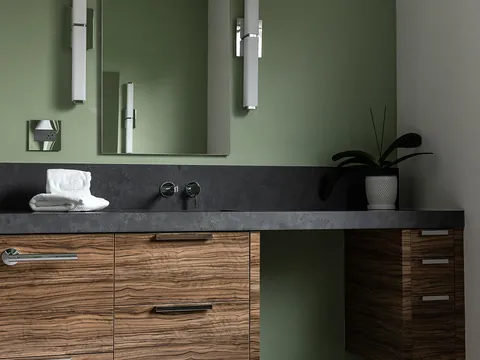
| Wall-mount | None in the counter; valve in the wall | Clean counter; suits vessel and floating vanities | Valve and spout length set before tile; access for service | Higher |
| Touchless (sensor) | One | Hands-free; often in powder rooms | Needs a battery or power; more parts | Higher |
Matching the faucet to the sink
Three numbers on the spec sheet decide whether a faucet works with your sink.
- Spout reach is the distance from the faucet base to the center of the stream. The water should land near the drain. Too short, and it hits the back of the bowl and you scrape your knuckles on the faucet; too long, and it splashes over the front.
- Spout height is the clearance under the outlet. A tall spout over a shallow bowl splashes. A vessel sink needs a spout that clears the rim.
- Handle clearance. A single lever that tips back for hot water can hit a backsplash ledge, a full-height splash or a mirror set close behind it.
For a wall-mount faucet, spout length is fixed by the model and the valve is set in the wall before tile, so the vanity, counter depth and sink position must be final first. Our vanity sizes and heights page covers depths.
What is inside
- Cartridge. A ceramic disc cartridge uses two hard polished discs that slide over each other. It resists wear and mineral grit far better than rubber washers. Insist on it, and check that replacement cartridges are available.
- Body. Solid brass and stainless steel bodies are heavier and more durable than zinc or plastic. Weight in the hand is a rough guide.
- Drain. Many faucets come with a matching pop-up drain. Make sure it suits the sink: a sink without an overflow takes a drain made for no overflow.
- Standard. Lavatory faucets are made to ASME A112.18.1/CSA B125.1, Plumbing Supply Fittings. The spec sheet should name it, along with certification of the materials that touch drinking water.
Flow limits in Washington
Washington sets a stricter limit than either the federal standard or the WaterSense label, so read flow rates carefully. As of October 2026:
| Rule | Maximum flow for a residential bathroom faucet | Source |
|---|---|---|
| Washington plumbing code (what may be installed) | 1.2 gallons per minute at 60 psi, and at least 0.8 gpm at 20 psi | Washington's amendments to the plumbing code, WAC 51-56-0400 |
| EPA WaterSense label | 1.5 gallons per minute | EPA WaterSense bathroom faucet specification |
| Federal limit | 2.2 gallons per minute at 60 psi | 10 CFR 430.32, for faucets made after January 1, 1994 |
What that means in practice:
- A WaterSense label alone does not prove a faucet meets Washington's installed limit. Look for 1.2 gpm or less on the spec sheet or aerator.
- Washington's appliance efficiency law, RCW 19.260.050, also bars the sale of lavatory faucets and replacement aerators manufactured on or after January 1, 2021 that do not meet the state standard.
- Most of the flow you feel comes from the aerator. A well-designed one makes 1.2 gpm feel full.
- Code details for the rest of the bathroom are on our bathroom plumbing code page, and water savings are on rebates and water savings.
Finishes in Vancouver water
| Finish | How it wears | Water spots |
|---|---|---|
| Polished chrome | Very durable; easy to match | Shows them, but wipes clean easily |
| Brushed nickel and stainless tones | Durable | Hides them well |
| Brushed brass, gold and bronze tones (PVD) | Very hard, scratch-resistant coating | Brushed versions hide them well |
| Matte black | Depends on the process; coated versions can chip | Shows pale mineral film clearly |
| Living finishes (unlacquered brass) | Darkens and changes with use | Blend into the patina |
Ask how the finish is made, since the same color name can be a hard vapor-deposited coating from one maker and paint from another. Finishes rarely match exactly between makers, so buy the faucet, drain and shower trim in the same line if matching matters. See bathroom fixture finishes.
Older homes and lead
The City of Vancouver says the main source of lead in drinking water here is household plumbing installed before 1986, and that lead was used in higher concentrations in some brass fixtures before then. The City certifies no lead service lines in its distribution system. A remodel is a good time to replace an older faucet and the supply stops under it. For more on what older Vancouver bathrooms tend to hide, see bathrooms by home era.
What to check before you buy
- Faucet type and hole count, matched to the sink and countertop.
- Spout reach and height against the bowl.
- Handle clearance to the backsplash and mirror.
- Ceramic disc cartridge and parts availability.
- Rated flow of 1.2 gpm or less at 60 psi.
- The standard (ASME A112.18.1/CSA B125.1) and drinking water material certification.
- Finish process, not just the color name.
- Drain type: overflow or no overflow.
- For wall-mount: valve, spout length, and service access.
Who should choose which
- Most vanities: a single-hole, single-lever faucet with a brushed finish. One hand, one hole, easy to clean around.
- Traditional baths: a widespread faucet with cross or lever handles.
- Vessel sinks: a wall-mount faucet, or a tall vessel faucet with the right reach.
- Anyone with limited grip: lever handles or a touchless faucet. See aging-in-place bathrooms.
- Kids' baths: a single lever with a temperature limit, in a finish that hides spots.
Replacing a faucet can bring a plumbing permit into play in the City of Vancouver; see do you need a permit. JDI Construction confirms the faucet, sink and top together before the countertop is drilled. To plan your vanity, start with bathroom remodeling in Vancouver, WA.
Common questions
Is a WaterSense-labeled bathroom faucet enough for Washington?
Not necessarily. WaterSense bathroom faucets flow at no more than 1.5 gallons per minute, while Washington's plumbing code limits residential lavatory faucets to 1.2 gallons per minute at 60 psi. Check the rated flow on the spec sheet, or the marking on the aerator, for 1.2 gpm or less.
Why does my new faucet run so gently?
Because the flow limit in Washington is low: 1.2 gallons per minute at 60 psi for a residential bathroom faucet. A good aerator makes that flow feel full. If the stream is weak or uneven, unscrew the aerator and clean out grit and mineral scale, which is common after any plumbing work.
What is the difference between centerset and widespread?
Both have separate hot and cold handles and use three holes. A centerset faucet joins the spout and handles on one base, for a narrow hole spread. A widespread faucet has three separate pieces that can be spaced further apart, which looks more traditional and leaves more room to clean between them.
Should my old faucet be replaced if the house is older?
If it is a faucet from before 1986, it is worth considering. The City of Vancouver says lead was used in higher concentrations in some brass fixtures before 1986. The City also advises cleaning faucet aerators regularly to remove any captured particles.
Do wall-mount faucets leak into the wall?
Not if the valve is installed and tested correctly. The valve body is a pressure-tested plumbing fitting, the same idea as a shower valve. Plan an access route for the valve, from the back side of the wall or through the trim, so it can be serviced without removing tile.
- WAC 51-56-0400: Washington amendments to the Uniform Plumbing Code, fixture flow rates
- RCW 19.260.050: Washington efficiency standards, limits on sale
- U.S. EPA WaterSense: Bathroom faucets
- 10 CFR 430.32: Federal energy and water conservation standards (eCFR)
- CSA Group: ASME A112.18.1/CSA B125.1, Plumbing Supply Fittings (2024)
- City of Vancouver: Lead and drinking water
- City of Vancouver: 2025 Annual Water Quality Report
Checked October 2026. Rules, fees and programs change; confirm the current requirement with the agency before you rely on it.
Keep going
- JDI ConstructionBathroom remodeling in Vancouver, WAOur bathroom remodeling service, recent projects and what to expect.
- Exploring · Vanities, toilets and fixtures in depthChoosing a Toilet: Flush Ratings, Heights, Shapes and Wall-Hung OptionsHow to choose a toilet in Vancouver, WA: Washington's 1.28 gallon flush limit, WaterSense and MaP testing, bowl height and shape, rough-in and wall-hung options.
- Exploring · Vanities, toilets and fixtures in depthBidets and Bidet Seats: Planning Power and WaterBidets and bidet seats for a Vancouver, WA bathroom: stand-alone, seat and integrated toilet options, the outlet beside the toilet, water supply and backflow.
- Exploring · Vanities, toilets and fixtures in depthBathroom Mirrors and Medicine CabinetsChoosing bathroom mirrors and medicine cabinets: sizing to the vanity, lighted and defogging mirrors, recessed vs surface cabinets, and what is inside the wall.