Marble, Travertine and Natural Stone in Bathrooms
By the JDI Construction teamReviewed by Arthur Kulchitskiy, Project Consultant, and Denise Lacquement, Designer (bathroom specialist)Updated October 20265 min read
Natural stone works in a bathroom if you choose the stone and finish for the spot. Marble, travertine, limestone and onyx contain calcite and etch when acids touch them; sealing does not prevent etching. Polished stone did not meet the 0.42 wet slip benchmark in a Natural Stone Institute study, so floors and shower floors should be honed or textured.
Stone gives a bathroom something porcelain imitates but cannot copy: real depth, veining that never repeats, and a surface that ages. It also asks more of you. Some stones react to everyday acids, all of them need the right finish to be safe when wet, and they need gentler cleaning than tile. None of that rules stone out. It means choosing the stone and the finish for the spot, and knowing what you are signing up for.
The two families of stone
The most useful split is chemical. The Natural Stone Institute explains that acids affect stones containing calcite or dolomite: marble, dolomitic marble, limestone, travertine and onyx. Those are the calcareous stones. Granite, true quartzite, slate and soapstone are siliceous or otherwise non-calcareous, and do not etch the same way.
| Stone | Etches with acid | Typical bathroom uses | Character | Relative cost |
|---|---|---|---|---|
| Marble | Yes | Shower walls, floors (honed), vanity tops, mosaics | Veining, soft and luminous | Mid to highest |
| Travertine | Yes | Floors, shower walls; tumbled versions on shower floors | Natural holes, usually filled; warm tones | Mid |
| Limestone | Yes | Walls, floors in low-traffic rooms | Quiet, even color; softer | Mid to higher |
| Slate | Generally no | Floors, shower floors, walls | Cleft texture, dark tones, good grip | Lower to mid |
| Granite | Generally no | Vanity tops, sometimes floors | Speckled, very hard | Mid |
| Quartzite (true) | No | Vanity tops, slab walls | Marble-like veining, very hard | Higher to highest |
Stone names in showrooms are trade names, not geology. A stone sold as quartzite may contain calcite, and some "marbles" behave differently from others. Testing a sample at home, as described below, tells you more than the name.
Etching is not staining
These are two different problems, and people mix them up.
- Etching is a chemical reaction. Acid dissolves a tiny amount of the stone's surface and leaves a dull spot, removing the polish on marble and travertine. The Natural Stone Institute describes it as cosmetic: it does not affect the stone's strength or life. Common bathroom culprits are some toilet bowl and tub cleaners, vinegar-based cleaners, citrus, some toothpastes and mouthwashes, and some hair and skin products.
- Staining is absorption. A colored liquid or oil soaks into the pores and darkens the stone. This is what sealer helps with.
The key fact, in the Natural Stone Institute's own words: sealing does not prevent etching. Occasional re-honing or re-polishing removes etch marks. If you want a marble shower that stays looking new without effort, choose a honed finish, where etching blends in, or choose a stone-look porcelain instead.
Sealing
Most stone in a bathroom should be sealed, and marble should be sealed before a shower is used. The Natural Stone Institute recommends a sealer with a life expectancy of 10 to 15 years that resists both water-based and oil-based stains. It also notes that most granite countertops do not need sealing, which is a reminder that the need depends on the specific stone.
How often to reseal depends on the sealer, the stone and how much water the surface sees. Follow the sealer maker's schedule. A simple home test is to drop water on the stone: if it darkens within a few minutes, it is absorbing and needs attention.
Slip resistance when wet
Finish matters more than stone type. In a Natural Stone Institute lab study, polished finishes did not meet the 0.42 wet DCOF benchmark as an average in any stone type tested, though some softer individual specimens did. The study tested honed finishes at different grits to find where they reach 0.42. The 0.42 figure is the Interior, Wet level in ANSI A326.3, the slip test standard for hard flooring.
The practical rule for a bathroom: polished stone on walls and vanity tops, honed, tumbled, brushed or cleft stone on floors, and small honed or tumbled mosaics on shower floors.
Cleaning stone in a bathroom
Clean stone with a neutral cleaner, around pH 7, as the Natural Stone Institute advises. Vinegar and harsh cleaners can damage it. In practice:
- Squeegee or towel the shower walls after use. It cuts down on soap film and mineral spots, which are what tempt people toward acidic cleaners.
- Use a pH-neutral stone cleaner for routine cleaning, and keep the bathroom's other cleaners away from the stone.
- Do not use abrasive powders or scrub pads on polished stone.
- Wipe up spills of cosmetics, hair dye and mouthwash promptly.
Where stone works well
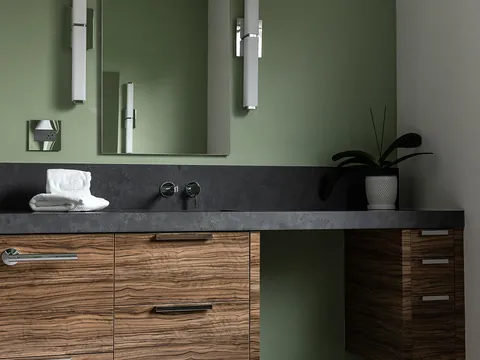
- Vanity tops and walls outside the shower. Lowest risk. Polished marble is fine here with reasonable care. Vanity counters are covered in vanity countertops.
- Shower walls. Workable with sealing and neutral cleaners. Honed hides etching; polished shows every mark.
- Bathroom floors. Honed or textured stone. A stiff, flat floor structure is essential, because stone is rigid and can crack over a floor that flexes.
- Shower floors. Small honed or tumbled mosaics, or slate. The slope to the drain and many joints add grip.
- Steam showers and wet rooms. Possible, but the waterproofing and maintenance demands go up. See steam showers.
Stone behind tile still needs a waterproof layer. The membrane standard ANSI A118.10 covers bonded waterproof membranes for both ceramic tile and dimension stone, and the overview is in waterproofing explained.
Who should choose stone, and who should not
- Choose marble or travertine if you like a surface that shows its age, will use neutral cleaners and accept occasional honing.
- Choose slate or a honed granite if you want real stone underfoot with less worry about etching.
- Choose stone-look porcelain for a busy family bathroom, a rental, or if you want a marble look with no sealing or special cleaners. Compare it on porcelain vs ceramic tile.
What to check before you buy
- The stone's actual type and whether it contains calcite. Put a drop of lemon juice on a sample for a few minutes, rinse and look for a dull spot.
- The finish for each surface: polished, honed, tumbled or cleft.
- A wet slip result, or at least a honed or textured finish, for any floor stone.
- Thickness, flatness and whether pieces vary in size (stone often does).
- The sealer the supplier recommends and how to test when it needs renewing.
- Whether you see the actual lot. Stone varies from batch to batch, so approve the boxes, not just a sample.
- Enough extra material, since replacements may not match.
JDI's designers help clients choose where stone earns its keep and where a porcelain look-alike is the better call. See how we plan a bathroom remodel in Vancouver, or book a free consultation to look at samples in your own light.
Common questions
Can marble be used in a shower?
Yes, with the right expectations. Seal it before use, clean it with a neutral cleaner, and accept that acidic products will dull spots over time. Honed marble hides etching better than polished, and on the shower floor a honed mosaic gives better grip.
How often does stone in a bathroom need resealing?
Follow the sealer maker's schedule rather than a fixed rule. You can test by putting a few drops of water on the stone: if it darkens quickly, the stone is absorbing water and the sealer may be worn. Showers wear sealer faster than a powder room floor.
Will a stone tile floor be cold?
Stone feels cool underfoot, more so in a Pacific Northwest winter. Electric floor heat under stone is a common pairing because stone holds and spreads the warmth well. See the heated floors page for how the systems work.
Can etch marks be removed?
Yes. The Natural Stone Institute notes that etching is cosmetic and that re-honing or re-polishing removes it. Light marks on honed stone can sometimes be blended by a stone restoration professional; deep or widespread etching on polished stone usually needs professional refinishing.
Is quartzite the same as marble?
No. True quartzite is a hard, quartz-based stone and does not etch the way calcite stones do. Some stones are sold as quartzite but contain calcite. Test a sample with a drop of lemon juice before you commit, and ask the supplier for the stone's geological classification.
- Natural Stone Institute: Sealing stone
- Tile Council of North America: Dynamic coefficient of friction FAQ (ANSI A326.3)
- Tile Council of North America: ANSI standards list (A118.10 membranes for tile and dimension stone)
- City of Vancouver: 2025 Annual Water Quality Report (hardness)
Checked October 2026. Rules, fees and programs change; confirm the current requirement with the agency before you rely on it.
Keep going
- JDI ConstructionBathroom remodeling in Vancouver, WAOur bathroom remodeling service, recent projects and what to expect.
- Exploring · Tile, floors and walls in depthLarge-Format Tile and Porcelain Slabs in BathroomsLarge-format tile and porcelain slabs in bathrooms: the 15 and 23 inch thresholds, flatness and lippage, linear drains on shower floors and slab walls.
- Exploring · Tile, floors and walls in depthZellige, Handmade and Glazed Accent TileZellige, handmade and glazed accent tile in bathrooms: what the variation looks like installed, chips and crazing, sealing, grout joints and where to use it.
- Exploring · Tile, floors and walls in depthBathroom Tile Patterns: Stacked, Offset, Herringbone and MoreBathroom tile patterns compared: stacked, offset, herringbone, chevron, basketweave and hex, the 33 percent offset rule and planning around niches.