Bathroom Vanity Countertops: Quartz, Marble, Solid Surface and More
By the JDI Construction teamReviewed by Arthur Kulchitskiy, Project Consultant, and Denise Lacquement, Designer (bathroom specialist)Updated October 20265 min read
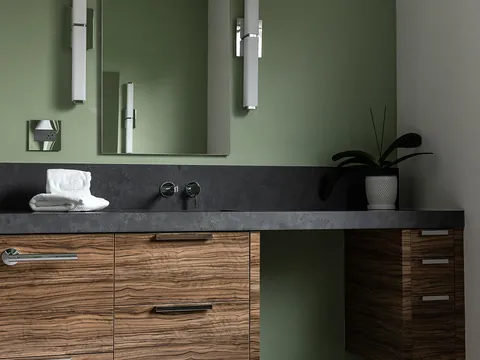
Quartz is the low-maintenance default for vanity tops: non-porous, stain resistant and consistent, though hot styling tools should not rest on it. Granite is tough and heat tolerant. Marble is beautiful but etches from acidic products and harsh cleaners. Solid surface and cultured marble allow a seamless integrated sink at a lower cost. Porcelain slab is thin, hard and stain resistant.
A vanity countertop is small, so it is a good place to use a material you love without a kitchen-sized bill. It also faces different threats than a kitchen counter: hair dye, nail polish remover, toothpaste, perfume, hot styling tools and the mineral film left by water. This page compares the common vanity top materials for how they hold up to bathroom use. For deeper material detail, the kitchen guide's pages on quartz vs granite and marble apply here too.
Vanity top materials compared
| Material | Cosmetics and dye | Heat (styling tools) | Acids and cleaners | Integrated sink | Relative cost |
|---|---|---|---|---|---|
| Quartz (engineered stone) | Resists stains well | Resin can discolor or scorch; use a mat | Not affected in normal use | Rarely; usually undermount | Mid to higher |
| Granite | Varies by stone; most resist well | Tolerates heat well | Generally resistant | No; undermount or vessel | Mid to higher |
| Marble | Can stain; light colors show it | Tolerates heat | Etches from acids and many cleaners | Carved sinks exist at high cost | Higher |
| Quartzite | Varies; dense stones resist well | Tolerates heat well | Genuine quartzite resists acids; test the slab | No | Higher to highest |
| Porcelain slab | Resists stains well | Tolerates heat well | Not affected | Some fabricated designs | Mid to higher |
| Solid surface | Can stain but sands out | Can scorch or soften | Resistant | Yes, seamless | Mid |
| Cultured marble | Good while the gelcoat is intact | Can craze or scorch | Resistant; abrasives dull it | Yes, molded as one piece | Lower to mid |
| Laminate | Resists well | Can scorch or blister | Resistant | No; drop-in sink | Lowest |
Quartz
Quartz is ground quartz bound with resin and pigments. It is non-porous, so hair dye, makeup and toothpaste wipe off, and it never needs sealing. The color and pattern are consistent, so the vanity top will match the sample. Its weakness is concentrated heat: the resin can discolor or scorch under a curling iron or flat iron left on it. Keep a heat mat on the counter or a holder on the wall. For most households, quartz is the default bathroom vanity top.
Granite and quartzite
Granite is hard, tolerates heat and resists most bathroom products. The Natural Stone Institute says most granite countertops do not need to be sealed, and recommends that when a sealer is used, it is a quality product with a life expectancy of 10 to 15 years that resists both water and oil-based stains. Light, porous granites can absorb oils from lotions, so ask the fabricator about your specific slab.
Quartzite is a natural metamorphic stone, harder still. The name is used loosely in the trade, and some stones sold as quartzite are softer, acid-sensitive marbles. Test a sample with lemon juice before you commit.
Marble
Marble is the classic bathroom stone, and many people accept its patina. Know what you are signing up for. Marble contains calcite, which reacts with acids. Toothpaste, mouthwash, some perfumes, citrus products and many bathroom cleaners can etch the polished surface, leaving dull marks. Sealing makes marble more stain resistant, but it does not prevent etching. The Natural Stone Institute notes that etch marks can be removed by re-polishing or re-honing.
- A honed (matte) finish shows etching far less than a polished one.
- Clean with a neutral, stone-safe cleaner. Vinegar and acidic bathroom sprays damage it.
- A tray for bottles and products keeps rings off the stone.
The kitchen guide's page on living with marble goes deeper; most of it applies in the bathroom.
Solid surface and cultured marble
Solid surface is an acrylic or polyester material, the same color all the way through. Its great advantage is an integrated sink: the bowl and top are joined so there is no seam or rim to collect grime. Scratches and stains sand out. It can scorch from heat and feels less like stone than quartz.
Cultured marble is cast stone dust and resin with a glossy gelcoat, usually molded with the sink as one piece. It is common on stock vanities at lower cost. The gelcoat is the protective layer; abrasive cleaners dull it and hot tools can craze it. More on this material in our blog post on cultured marble.
Porcelain slab and laminate
Porcelain slabs are large, thin sheets of fired porcelain. They resist stains, heat and acids, and suit modern rooms. The pattern is printed on the surface, and on some slabs the edge does not carry the pattern, so the edge profile is limited. See the kitchen guide's page on porcelain and sintered stone countertops.
Laminate is the lowest-cost top. It works well for a rental or a quick refresh but cannot take an undermount sink, and water left at seams or around the sink cutout can swell the core.
Hard water and vanity tops
Integrated sinks, edges and backsplashes
- Integrated sinks (solid surface, cultured marble, some porcelain designs) have no seam between bowl and counter. They are the easiest to clean. If the bowl is damaged, the whole top is usually replaced.
- Undermount sinks in stone or quartz leave a polished edge at the cutout and let you wipe straight into the bowl. See bathroom sinks.
- Edges. A softened or eased edge resists chipping and is kinder to hips in a tight room than a sharp square edge. Mitered edges make a thin slab look thick. The kitchen guide's page on edges and thickness shows the profiles.
- Backsplash. The common choices are a short splash of the same material, a full-height splash to the mirror, or tile. A full-height splash avoids a grout line where water collects behind the faucet. Decide before the mirror and lights are placed.
- Faucet holes. Holes are drilled for the faucet you chose. Once drilled in stone they are permanent, so finalize the faucet first. See bathroom faucets.
What to check before you buy
- How the material handles heat, if you use styling tools at the vanity.
- Whether it is acid sensitive, and which cleaners are safe.
- For natural stone: see the actual slab, and test a sample with an acid and an oil.
- The sink type and whether the material allows it (undermount, integrated, vessel).
- Faucet hole count and spacing, confirmed before fabrication.
- Edge profile and backsplash height.
- Whether the vanity cabinet is built to carry the top's weight and thickness.
Who should choose which
- Busy family or kids' baths: quartz or porcelain. Nothing to seal, little to stain.
- A primary bath where you want natural stone and low upkeep: granite or a tested quartzite.
- Lovers of classic marble: honed marble, with a tray for products and an acceptance of patina.
- A seamless, easy-clean sink: solid surface or cultured marble with an integrated bowl.
- Powder rooms and budget updates: a remnant of quartz or granite, or a cultured marble top.
JDI Construction coordinates the top, sink and faucet before the countertop is templated, so the holes and the sink cutout are made once. To plan your vanity and countertop, start with bathroom remodeling in Vancouver, WA, or read more about bathroom vanities.
Common questions
Will a curling iron damage a quartz vanity top?
It can. Quartz contains a resin binder that can discolor or scorch under concentrated heat. Rest hot styling tools on a heat-resistant mat or in a holder, not on the counter itself. Granite and porcelain tolerate heat better.
Does a marble vanity top need sealing?
Sealing helps marble resist stains, but it does not stop etching. Acidic products and many bathroom cleaners dull the polished surface whether the stone is sealed or not. The Natural Stone Institute says etch marks can be removed by re-polishing or re-honing.
What is the most hard-water-friendly vanity top?
Non-porous, non-acid-sensitive surfaces: quartz, porcelain and granite. Mineral spots wipe off them, and the mild acidic cleaners used on hard-water film do not harm them. On marble, those same cleaners etch, so mineral film has to be prevented with daily wiping rather than removed with acid.
Can I use a kitchen countertop remnant for a vanity?
Often, yes. Vanity tops are small, and fabricators frequently have remnants of quartz, granite and other stone left over from kitchen jobs. Selection is limited to what is in stock, and the remnant still needs cutting, edging and sink cutouts.
- Natural Stone Institute: Sealing natural stone countertops
- City of Vancouver: 2025 Annual Water Quality Report
Checked October 2026. Rules, fees and programs change; confirm the current requirement with the agency before you rely on it.
Keep going
- JDI ConstructionBathroom remodeling in Vancouver, WAOur bathroom remodeling service, recent projects and what to expect.
- Exploring · Vanities, toilets and fixtures in depthBathroom Sinks: Undermount, Vessel, Integrated and PedestalBathroom sinks compared: undermount, drop-in, vessel, integrated, pedestal and wall-mount types, materials, splash, overflows, faucet fit and accessibility.
- Exploring · Vanities, toilets and fixtures in depthBathroom Faucets: Single-Hole, Widespread and Wall-MountChoosing a bathroom faucet: single-hole, centerset, widespread and wall-mount types, spout reach, cartridges, Washington's 1.2 gpm limit and finishes.
- Exploring · Vanities, toilets and fixtures in depthChoosing a Toilet: Flush Ratings, Heights, Shapes and Wall-Hung OptionsHow to choose a toilet in Vancouver, WA: Washington's 1.28 gallon flush limit, WaterSense and MaP testing, bowl height and shape, rough-in and wall-hung options.