Porcelain vs Ceramic Tile for Bathrooms
By the JDI Construction teamReviewed by Arthur Kulchitskiy, Project Consultant, and Denise Lacquement, Designer (bathroom specialist)Updated October 20265 min read
Porcelain is the denser of the two. TCNA defines it as tile with water absorption of 0.5 percent or less under ASTM C373; non-porcelain ceramic absorbs more. In a bathroom, porcelain is the usual choice for floors and shower floors because it resists chipping and water. Glazed ceramic works well on shower and dry walls, costs less and is easier to cut.
Porcelain and ceramic are both made from clay and fired in a kiln, and in a showroom they can look identical. The difference is inside the tile: how dense it is, how much water it takes in, and how it behaves when you cut it, drop something on it or walk on it wet. In a bathroom, that difference decides which surfaces each one belongs on.
The dividing line: water absorption
The Tile Council of North America (TCNA) defines porcelain as impervious tile with water absorption of 0.5 percent or less, measured by the ASTM C373 test. Tile that absorbs more than that is non-porcelain ceramic, often just called ceramic. The general standard for both is ANSI A137.1, in its 2022 edition.
The label on the box is not always the test result. The Porcelain Tile Certification Agency (PTCA) tests tile independently so makers can prove it meets the 0.5 percent line, and certified tile may carry the PTCA mark on its packaging. If a product is priced as porcelain and you are relying on that for a floor, ask for the mark or the test.
Side by side
| Porcelain | Non-porcelain ceramic | |
|---|---|---|
| Water absorption | 0.5 percent or less (TCNA) | More than porcelain |
| Body | Dense, hard, fine-grained | Softer, lighter, more porous |
| Chip resistance | Higher | Lower; chips show the clay color under the glaze |
| Floors | The usual choice | Only where the maker rates it for floors |
| Shower walls | Yes | Yes, very common |
| Shower floors | Yes, in textured or mosaic form | Seldom |
| Sizes available | Mosaic to large format and slabs | Mostly small and mid sizes, many wall formats |
| Cutting and drilling | Harder; needs good wet saws and diamond bits | Easier, including for curves and outlet cutouts |
| Setting mortar | One suited to dense tile | Bonds readily to most thin-set mortars |
| Relative cost | Mid to higher | Lower to mid |
Glazed, through-body and color-body
Porcelain comes in three constructions, and they matter more than people expect.
- Glazed porcelain has a glass-like surface layer carrying the color and pattern. Most stone-look and wood-look porcelain is glazed and printed. If it chips, the body color shows.
- Color-body porcelain has a body tinted close to the glaze color, so a chip is much less visible.
- Through-body (unglazed) porcelain is the same material all the way through, with no separate glaze. It hides chips and wear but can take stains on the surface and may need a sealer the maker recommends.
Ceramic wall tile is almost always glazed. The glaze is what makes it easy to clean and resistant to water on the face; the body behind it is porous, which is why it bonds so easily to mortar.
How each behaves in a bathroom
On the floor
A bathroom floor is walked on wet, sometimes with dropped bottles, hair tools and the occasional toilet tank lid. Porcelain shrugs off most of that. Whichever you choose, the slip rating matters more than the body. ANSI A326.3 (2021) sorts hard flooring into use categories; for a bathroom floor, look for Interior, Wet, which requires a wet DCOF of 0.42 or more or a maker's declaration. A matte or textured finish helps. Polished porcelain is the riskiest finish when wet.
On shower walls
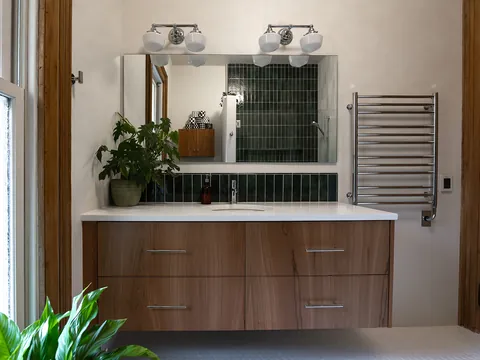
Here ceramic earns its place. Nobody walks on a wall, glazed ceramic cleans easily, and it comes in many classic wall formats like 3 by 6 subway, 4 by 4 squares and handmade-look edges. It is also lighter, which makes it easier to set on vertical surfaces. Porcelain works just as well on walls and is the only option once you go to large panels.
On the shower floor
Shower floors are almost always porcelain mosaics or stone mosaics. The small pieces follow the slope to the drain, and the many grout joints add grip. Ceramic mosaics exist, but few are rated for wet floors.
Cutting and installation
Porcelain is harder on tools and installers. Every cut for a valve, a niche edge or an outlet takes longer, holes for grab bars need diamond bits, and mistakes are expensive with large pieces. Dense porcelain also bonds less readily, so tile setters use a mortar suited to it. The modified thin-set mortar standards are ANSI A118.4 and A118.15 (both 2023); ask your installer which their mortar meets and confirm it is the one the tile maker calls for.
Ceramic cuts cleanly with simple tools and takes curves and notches more easily. That is one reason it remains common on busy wall layouts with many cutouts. Its softness is also why its edges chip more easily during cutting, so careful installers cut it slowly and keep factory edges where they show.
Cost and value
As a material, ceramic is usually the lower-cost tier and porcelain mid to higher, with large and rectified porcelain at the top. Labor shifts the picture. Porcelain takes longer to cut, and large-format porcelain needs a flatter base. On the other hand, a floor that chips and needs repairs costs more over its life. For how tile fits the overall budget, see where the money goes in a bathroom remodel.
Who should choose which
- Choose porcelain for the bathroom floor, the shower floor, any tile larger than about 15 inches on a side, any surface where a dropped object is likely, and any wood-look or stone-look design.
- Choose glazed ceramic for shower walls, tub surrounds and wainscot when you want classic wall shapes, a lower material cost or many cutouts.
- Mix them in most bathrooms: porcelain underfoot, ceramic on the walls. This is common and sensible, as long as the colors are chosen together in the room's light.
- Look beyond both if you want the real variation of stone or handmade tile. Read natural stone in bathrooms or zellige and handmade tile.
What to check before you buy
- For porcelain, the PTCA mark or a test result at 0.5 percent absorption or less.
- The maker's allowed uses: floor, wall, wet areas.
- A wet slip classification for any floor tile.
- Glazed, color-body or through-body, and whether the maker recommends a sealer.
- Rectified or calibrated edges, which set the grout joint width.
- Matching trim pieces or a plan for metal edges.
- The same shade and caliber lot on every box.
Choosing tile is easier with the room in front of you. At JDI, Denise Lacquement walks clients through tile choices during design, and the 3D layout shows the tiles in place before anything is ordered. Start with a free in-home consultation, or read more about our Vancouver bathroom remodeling.
Common questions
Is porcelain tile waterproof?
The tile body absorbs very little water, but a tiled shower is not waterproof because of the tile. Water passes through cement grout and around fixtures, so the waterproofing has to be a membrane or board system behind the tile. That is true for porcelain and ceramic alike.
How can I tell if a tile is really porcelain?
Look for the Porcelain Tile Certification Agency mark on the box or ask for the absorption test result. Weight and a hard, fine-grained body are hints, but they are not proof. Some products sold as porcelain do not meet the 0.5 percent line.
Is ceramic tile safe for a bathroom floor?
It can be, if the maker rates it for floors and gives it a wet slip classification of Interior, Wet. The softer body chips more readily if something heavy is dropped, and a chip in a glazed tile shows the clay underneath. For a family bathroom floor, porcelain is the lower-risk choice.
Does porcelain need to be sealed?
Glazed porcelain does not need sealing. Some unglazed or polished porcelain benefits from a sealer the maker recommends, because the surface can hold stains. The cement grout between tiles is a separate question and usually does need sealing.
- Tile Council of North America: Porcelain tile certification (0.5 percent water absorption, ASTM C373, PTCA)
- Tile Council of North America: ANSI standards list (A137.1 ceramic tile, A118.4 and A118.15 mortars)
- Tile Council of North America: Dynamic coefficient of friction FAQ (ANSI A326.3)
- Tile Council of North America: 2026 Tile Initiative (A326.3 Table 1)
Checked October 2026. Rules, fees and programs change; confirm the current requirement with the agency before you rely on it.
Keep going
- JDI ConstructionBathroom remodeling in Vancouver, WAOur bathroom remodeling service, recent projects and what to expect.
- Exploring · Tile, floors and walls in depthMarble, Travertine and Natural Stone in BathroomsMarble, travertine, limestone, slate and granite in bathrooms: etching vs staining, sealing, slip resistance when wet, safe cleaners and where stone fits.
- Exploring · Tile, floors and walls in depthLarge-Format Tile and Porcelain Slabs in BathroomsLarge-format tile and porcelain slabs in bathrooms: the 15 and 23 inch thresholds, flatness and lippage, linear drains on shower floors and slab walls.
- Exploring · Tile, floors and walls in depthZellige, Handmade and Glazed Accent TileZellige, handmade and glazed accent tile in bathrooms: what the variation looks like installed, chips and crazing, sealing, grout joints and where to use it.