Design-Build Remodeler vs. Big-Box Store vs. Handyman for a Kitchen
By the JDI Construction teamReviewed by Arthur Kulchitskiy, Project ConsultantUpdated October 20265 min read
Match the provider to the job. A handyman suits small repairs; in Washington the registered handyman specialty stops under $2,000 and excludes permit work. A home-improvement store program suits installing what the store sells. A cabinet and counter installer suits a same-layout swap. A design-build remodeler earns its cost when walls, plumbing, gas or wiring move, permits are needed and several trades must be coordinated.
Not every kitchen project needs a remodeler. A loose hinge, a new faucet and a full gut with a moved wall are different jobs, and each has a kind of provider that fits it. This page compares four of them, sets out what Washington and Oregon law allow each to do, and is plain about when JDI is the wrong call. If you are choosing between design-build and hiring a separate designer and builder, that comparison is on our page about design-build versus a general contractor.
The four options side by side
| Handyman | Home-store installation program | Cabinet and counter installer | Design-build remodeler | |
|---|---|---|---|---|
| Fits | Small repairs and adjustments | Installing products the store sold you | New cabinets and tops in the same layout | Layout changes, multiple trades, permits |
| Designs the room | No | Usually limited to the products sold | Rarely; often works from a showroom plan | Yes |
| Plumbing, electrical, gas | Only with the separate trade credential | Depends on the program; ask | Usually left to others | Coordinated by the remodeler |
| Permits | Washington handyman specialty cannot do permit work | Ask who pulls them | Often not included | Handled as part of the job |
| Who you chase if it goes wrong | The handyman | Store, installer, or both; check the contract | The installer, for installation only | One company |
A handyman: right for small jobs, with legal limits
A good handyman is the sensible hire for swapping cabinet pulls, adjusting doors, replacing a damaged toe kick or patching drywall. The limits are where people get caught.
Washington
- Unregistered work stops at $500. RCW 18.27.090(9) exempts work on one project only when the total price for labor and materials is under five hundred dollars, and never for someone who advertises as a contractor or splits a job to stay under the line.
- The registered handyman specialty has its own ceiling. Under WAC 296-200A-016, a handyman must do all work personally, without employees or other specialty contractors, and is limited to "minor and casual work of existing residential maintenance and repair" with time and materials under two thousand dollars. "Work requiring a building permit may not be done by this specialty."
- Plumbing and wiring need their own credential. RCW 18.106.020 requires a plumbing certificate to do plumbing work, and RCW 19.28.041 requires an electrical contractor license to do electrical installation for others. The same WAC section says installing a dishwasher or garbage disposal needs a plumber certification and/or electrical license.
Oregon
- The exemption is under $1,000 and narrow. ORS 701.010(4) exempts a person whose total contracts on one structure or project are under $1,000, and only when the work is "of a casual, minor or inconsequential nature." It does not apply to anyone with a sign, card or advertising that suggests they are a contractor.
- Above that, a CCB license is required with the right endorsement (ORS 701.021). A residential limited contractor, for example, may not take a contract over $5,000 (ORS 701.038).
- Unlicensed work leaves you with fewer remedies. The Construction Contractors Board says it can only help "if the contractor was licensed during your construction project."
Home-improvement store installation programs
Large home-improvement retailers sell cabinets, counters, flooring and appliances, and many offer installation. These programs vary, so treat the following as questions to ask, not assumptions.
- Who is the contractor on your contract? Installation may be carried out by a separate company. Find out whether you are contracting with the store or with that company, and look up whichever signs, plus the company that sends the crew. Washington's definition of a contractor covers "cabinet or similar installation" (RCW 18.27.010), and Oregon's covers anyone who "arranges or undertakes" the work (ORS 701.005).
- What is in scope? Installation is generally tied to the products being sold. Moving a drain, adding a circuit, patching walls or refinishing the floor around new cabinets may be excluded or sold separately.
- Who measures, and who pays for a mistake? If cabinets arrive short, the contract should say whether that is the measurer's, the supplier's or the installer's problem.
- Who pulls permits and arranges inspections? Get the answer in writing. Our permit guide shows which kitchen work needs one.
For a straight replacement of products the store sells, in the same footprint, this can work well. It is a weaker fit once the job needs design decisions or trades the program does not cover.
A kitchen-only installer
Independent cabinet and countertop installers do one thing well: set boxes level, scribe fillers and trim, and get tops seated. Washington registers this as the "Cabinets, millwork and finish carpentry" specialty, and stone or tile tops fall under its own specialty. Hire one when you are keeping the layout and you, or a showroom, have already planned the cabinets. Before choosing, compare refacing versus replacing cabinets, since refacing changes who you need.
The gap is everything around the boxes. Someone still has to disconnect and reconnect the sink, move an outlet, patch the backsplash wall and schedule inspections. If nobody is named for those tasks, that someone is you.
A design-build remodeler
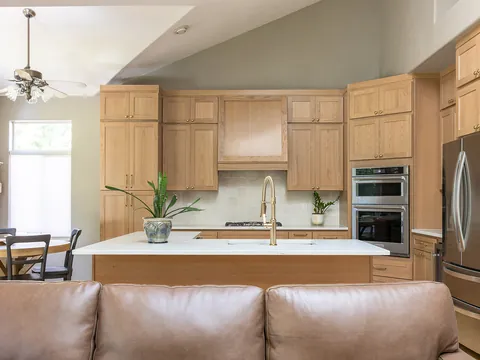
A design-build firm designs the kitchen and builds it with one accountable team. It is more than a small job needs. It earns its place when:
- the layout changes, or the sink, range or island moves;
- plumbing, gas lines or electrical circuits have to be relocated or added;
- a wall is opened or removed (see opening a kitchen wall);
- permits, inspections and engineering are involved;
- several trades have to be sequenced so nobody waits on anybody else.
For scale, JDI's published planning range for a small kitchen (under 120 square feet) at our Essential tier is $28,000-$45,000 before sales tax. That is a planning range, not a quote, and it shows why we are not the right hire for a hardware swap. Our page on kitchen remodel levels helps you place your own project.
When JDI is not the right fit
Be honest with yourself about the size of the job, and we will be too. You probably do not need us for:
- new cabinet hardware, hinge adjustments or a sticking drawer;
- a single repair, such as a cracked tile, a leaking trap or a damaged panel;
- a faucet or appliance swap in the same location (hire the licensed trade);
- repainting walls or cabinets with nothing else changing.
For those, a registered handyman or the right licensed trade is quicker and costs less. Countertop-only and cabinet-refacing jobs are different: JDI takes those, although most of our work is full remodels. See countertop or cabinet replacement without a full remodel. Whoever you hire, check their registration, which our page on verifying a Washington contractor walks through, and for Oregon work use the CCB's License Search.
If your project fits design-build
If your kitchen involves a new layout, moved plumbing or gas, an opened wall or permits, a design-build team will save you the coordinating. JDI Construction is a family-owned design-build contractor in Vancouver, operating since 2007 (Washington registration #JDICOCN932KZ, Oregon CCB #176101). We handle design, permits and project management, and back the work with a 5-year written workmanship warranty. Get a sense of the range with our kitchen cost calculator, then book a free in-home consultation.
Common questions
Can a handyman install a new kitchen sink or dishwasher in Washington?
Not as plain handyman work. Washington's appliance specialty rule says installing or replacing a dishwasher or garbage disposal requires plumber certification and/or an electrical license, and RCW 18.106.020 and RCW 19.28.041 require those credentials for anyone doing plumbing or electrical work for others. Ask to see the certificate, and check it in L&I's Verify tool.
Is a handyman who charges by the hour exempt from registration?
Billing method does not decide it. In Washington the exemption turns on the total price for the whole project being under $500 and the person not advertising as a contractor. In Oregon the test is under $1,000 total on one structure or project, work of a casual, minor or inconsequential nature, and no advertising, signs or cards.
What happens if I hire an unlicensed handyman in Oregon and the work goes wrong?
The Construction Contractors Board says it can only help if the contractor was licensed during your project, and complaints must be filed against a licensed contractor. Its enforcement staff may still penalize an unlicensed contractor, but the bond and the CCB dispute process are not available to you.
If a home store sells me cabinets and sends an installer, who do I look up?
Look up whoever signs the installation contract with you, and the company that actually sends the crew if it is a different business. Both should show an active Washington registration, or an Oregon CCB license for work in Oregon. Ask for the numbers before you pay for installation.
Does JDI take small kitchen jobs?
We take on remodels that involve design and several trades. For a hardware swap, a single repair or a faucet replacement, a registered handyman or the right licensed trade is usually the better and less costly choice, and we would say so if you called us about one.
- WAC 296-200A-016: Specialty contractor descriptions, including Handyman
- RCW 18.27.090: Exemptions from contractor registration
- RCW 18.27.010: Definitions (contractor, cabinet installation)
- RCW 19.28.041: Electrical contractor license required
- RCW 18.106.020: Plumbing certificate required
- Washington L&I: Hiring a Contractor, Remodeler, or Handyman (F625-084-000)
- ORS chapter 701: Construction Contractors (2025 edition)
- Oregon CCB: Consumer tools
Checked October 2026. Rules, fees and programs change; confirm the current requirement with the agency before you rely on it.
What kitchen clients say
This is our second time working with JDI... they do exceptional work and even more they stand begind the work they do which is getting rare these days. Looking forward to doing a Kitchen Remodel with them next, thanks again!
Anthony G. · Google review, May 13, 2026
JDI did a great job remodeling our rental house that needed a lot of work. They put in new floors, completely redid the kitchen and bathrooms. They also painted the entire interior. We had great communication and everything turned out fantastic.
Todd W. · Google review, Mar 15, 2026
The shower is stunning. I feel like I am in a spa. The new countertops and backsplash in the kitchen are beautiful. Art was great at keeping me informed every step of the project. The crew was so hard working and each was a perfectionist in what they did.
Virgil G. · Google review, Jan 7, 2026
Keep going
- Ready to hire · Hiring and getting startedDesign-Build vs. General Contractor vs. Kitchen DesignerDesign-build, general contractor or independent kitchen designer: how each model splits design, price and responsibility, and which suits your remodel.
- JDI ConstructionDesign-build remodelingWhy one team designs and builds your project.
- JDI ConstructionRequest a free consultationAn in-home visit, an itemized plan and a 3D design layout.
- Ready to hire · Hiring and getting startedKitchen Remodels We Have Done Around Vancouver and PortlandPhotos and write-ups of 27 kitchen remodels JDI Construction designed and built in Vancouver, Camas, Battle Ground, Portland and nearby.