Can You Live at Home During a Whole-House Remodel or Addition?
By the JDI Construction teamUpdated November 20265 min read
Sometimes. It depends on whether you keep a working bathroom and a place to cook, how long utilities are off, and how well the work area can be sealed from the rooms you use. In a house built before 1978, lead-safe work rules and the asbestos survey matter too. Phasing makes staying easier; work across the whole house at once usually means planning to move out for part of it.
For many families, the biggest question about a whole-house remodel or an addition is not the price. It is where they will live while it happens. Some households stay home through the whole project, some move out for part of it, and some leave for the duration. There is no single right answer, but there are a handful of questions that decide it for almost every house.
The questions that decide it
| Question | Staying is easier when... | Moving out is worth planning when... |
|---|---|---|
| Will you have a working bathroom? | At least one bathroom stays in service the whole time | Every bathroom is part of the work at the same time |
| Will you have a place to cook? | A temporary kitchen can be set up in a room outside the work | The kitchen is out for months and nothing can stand in |
| Will utilities be shut off? | Shutoffs are short and scheduled | Water, power or heat is off for long stretches, or in winter |
| Can the work area be sealed off? | The work is on one floor or one wing, with its own entry | The work runs through the middle of the house |
| Who lives there? | Adults who can live with noise and some dust | Young children, someone pregnant, health conditions, pets that react to noise |
| Does anyone work from home? | There is a quiet room away from the work | Calls and focus time happen during working hours next to the crew |
Kitchens and bathrooms decide most of it
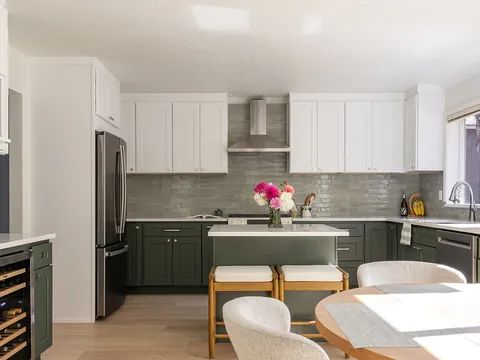
Noise and dust are tiring, but most households can live with them. What they cannot easily live without is a working toilet and shower, and a way to make simple meals. If the plan keeps one bathroom in service and leaves space for a temporary kitchen with a microwave, a hot plate, a refrigerator and a sink nearby, staying becomes realistic. Our page on living through a kitchen remodel covers temporary kitchens in detail.
When the kitchen and every bathroom are being redone together, as they often are in a whole-house remodel, many families plan to be somewhere else for at least that stretch.
Utilities, systems and the calendar
Whole-house projects often include electrical, plumbing and heating work. Some of it means shutting off water, power or heat while connections are made. Short, scheduled shutoffs are manageable. Longer ones, or a heating system replaced in January, change the answer. Ask for a rough sequence of when each system will be down, and plan around those dates rather than the whole project.
Older houses: lead paint and asbestos
If your house was built before 1978, plan for two more questions. EPA says a home built before 1978 is more likely to have lead-based paint, and that dust and paint chips from it are among the most common sources of lead exposure in homes. Approximately three-quarters of US homes built before 1978 still contain some lead-based paint, according to EPA.
In Washington, renovation for pay in pre-1978 housing has to follow the state's lead-safe work practice rules. Before the work starts, the firm must isolate the work area so that no dust or debris leaves it while the renovation is under way (WAC 365-230-330). If you plan to stay, ask how containment will be set up, how the area will be cleaned each day, and how the rooms you use will be kept separate.
Asbestos is the second question. Under the Southwest Clean Air Agency's rule SWCAA 476, effective March 22, 2026, the owner or the owner's agent must determine whether there are suspect asbestos-containing materials in the work area before any renovation, and either treat them as asbestos or have an accredited inspector survey them. If asbestos will be removed, the agency requires a notice and a 10-day waiting period before that work can begin. Plan that into the schedule, and into where you will be while it is removed.
Phasing makes staying easier
The most effective way to stay home is to build in phases, so that each phase leaves a working kitchen or bathroom. For example, the primary bathroom first while the hall bathroom stays in use, then the kitchen with a temporary kitchen set up elsewhere. Phasing costs more in total, about 5 to 10 percent over one continuous build according to JDI's calculator, and it stretches the calendar. Our page on remodeling all at once or in phases weighs that trade-off.
If you stay: how to make it work
- Agree on the boundaries. Which rooms are work areas, which are yours, and which entry the crew uses.
- Set working hours and quiet times that fit your household, within what the job needs.
- Protect what you keep. Move furniture and valuables out of work areas, and cover or store anything in the dust path.
- Plan for pets. Open doors, noise and new people unsettle most animals. A room they stay in, or a stay elsewhere, prevents escapes.
- Keep one communication channel with one contact for questions, so small worries do not turn into daily interruptions.
If you move out: what to plan
- Timing. Base the move-out window on the stretch when the kitchen and bathrooms are unusable, plus a margin. Construction schedules move, so a lease or stay you can extend is worth more than a slightly lower rate.
- Cost. Put temporary housing, storage and extra travel in the budget next to the construction price.
- Access and security. Decide how the crew gets in, who has keys and how the house is secured at night.
- Mail, insurance and utilities. Forward mail, and ask your insurer how a vacant or under-construction house is covered.
When staying is the wrong call
If someone in the house is pregnant, a young child spends time there and the home was built before 1978, or a household member has a health condition affected by dust, plan to be away for the disruptive stretches. The same goes for a house where every bathroom and the kitchen are out at once. Saving on rent is not worth months of strain.
Next step
Where you will live during the work is one of the first things to settle with your contractor, because it shapes the sequence and the schedule. See what to bring to your first consultation and raise it there.
Common questions
Is it safe to live in a house built before 1978 during a remodel?
It can be, when the work is done correctly. EPA says homes built before 1978 are more likely to have lead-based paint, and Washington's rules for paid renovation in those homes require the work area to be sealed off so no dust or debris leaves it. Children and pregnant household members are the reason to take this most seriously; ask how the work area will be contained and cleaned.
What is the hardest part of living at home during a whole-house remodel?
For most households it is losing the kitchen and bathrooms at the same time. Noise and dust are tiring, but a working bathroom and a simple place to cook decide whether staying is practical at all.
How long would I need to move out for?
That depends on the scope and sequence, which only a plan for your house can answer. JDI's calculator gives typical on-site times of 4 to 7 months for a standard whole-home refresh and 7 to 14 months for larger homes or projects with an addition. Many households move out only for the stretch when the kitchen and bathrooms are unusable, not for the whole project.
Does an addition let me stay home more easily than an interior remodel?
Often, because much of the work happens outside the existing rooms. The disruptive part is where the addition connects to the house, when a wall is opened, and any work on systems that serve the whole house.
- US EPA: Protect your family from sources of lead
- WAC 365-230-330: Work practice standards (renovation in pre-1978 housing)
- Southwest Clean Air Agency: SWCAA 476 Standards for Asbestos Control, Demolition and Renovation (effective March 22, 2026)
- Southwest Clean Air Agency: Asbestos
Checked November 2026. Rules, fees and programs change; confirm the current requirement with the agency before you rely on it.
Keep going
- Decide · Choosing who builds itYour First Whole-House, Addition or ADU Consultation: What to Bring and What HappensWhat to bring to a first whole-house, addition or ADU consultation with JDI in Vancouver or Portland, what we talk about, and what happens after the visit.
- Compare · Which way should you go?Whole-House Remodel: All at Once or Room by Room?Should you remodel the whole house in one build or room by room? Cost, disruption, permits, design and budget trade-offs for Vancouver and Portland homes.
- Learn · Whole houseRemodeling a mid-century Vancouver homeLead paint, asbestos, aluminum wiring and what to budget for.
- Compare · Which way should you go?Paying for a Whole-House Remodel, Addition or ADUHow people pay for a whole-house remodel, addition or ADU in Washington, and what to budget beyond the contract: sales tax, permit and impact fees, property tax.