Hall and Kids' Bathrooms: Durable Choices for Shared Baths
By the JDI Construction teamReviewed by Arthur Kulchitskiy, Project Consultant, and Denise Lacquement, Designer (bathroom specialist)Updated October 20265 min read
A shared hall bath needs to survive heavy daily use by several people. Keep a tub if young children live in the house, use a pressure-balance or thermostatic valve with its limit stop set (Washington caps shower water at 120°F), choose porcelain tile and a dense grout, give each person storage, and size the fan for steam. JDI's full-bath planning range starts at $20,000-$32,000.
The hall bathroom works harder than any other room in the house. It is shared by children, guests and sometimes the whole family on a school morning, and it takes splashing, wet towels on the floor and steam several times a day. Planning it is less about style and more about choosing things that stay safe, clean up easily and still work as the people using it grow up.
Keep the tub, or not?
For households with young children the answer is usually to keep it. Bathing a toddler in a walk-in shower is awkward, and a tub with a showerhead over it serves children now and teenagers later. The usual tub-and-shower combination fits a 5-foot alcove on one wet wall.
If the hall bath is the only tub in the house, removing it is a decision for your household and for a future sale, since some buyers with children look for one. If you have no young children and another bathroom has a tub, a walk-in shower can make the room easier for everyone. Our page on tub or no tub covers the choice in more depth.
Scald protection is required, so check the settings
The plumbing code Washington uses requires every shower and tub-shower combination to have a pressure-balance, thermostatic or combination valve that protects against scalding and sudden temperature changes, and it limits the water from a showerhead to 120°F. Water from a bathtub filler is also limited to 120°F.
These valves have a limit stop that the installer must set. ASSE, the standards body for these valves, notes that 120°F is usually the code maximum but the stop can be set lower at the homeowner's preference. For a children's bath, ask your plumber to set and test the stop before the job is signed off, and keep the instructions for adjusting it. ASSE also warns that low-flow showerheads should never be used with valves that do not compensate for pressure changes, which matters if an older valve is being kept. Valve types are covered on shower valves and controls.
Surfaces that take abuse
Choose for cleaning and for wet feet:
- Porcelain tile absorbs 0.5 percent of water or less by definition, which makes it a practical floor and wall tile for a family bath.
- Slip resistance. ANSI A326.3 sets a wet dynamic coefficient of friction of 0.42 or more for level interior floors expected to be walked on when wet. TCNA notes that the number does not predict whether a given person will slip, but it is a sensible floor for a bath where children step out of the tub. Ask for the rating on the spec sheet.
- Grout. Epoxy grout (ANSI A118.3) and high-performance cement grout (ANSI A118.7) are denser options than standard cement grout. A mid-tone or darker color hides daily wear. See grout and sealing.
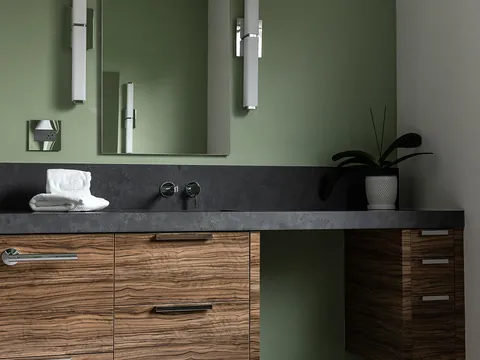
- Vanity top. Quartz and solid surface tops shrug off toothpaste and makeup better than porous stone. Marble and other calcite stones etch with acids, which a family bath will supply.
- Paint. Use a moisture-resistant bathroom finish on walls and ceilings. Sherwin-Williams recommends satin or semi-gloss for bathrooms.
Splash zones and water on the floor
Kids splash. Plan for water outside the tub, not just inside it. Waterproofing should extend properly around the tub and up the walls, and the code requires a nonabsorbent wall surface above a tub with a showerhead to at least 6 feet above the floor. Tile the floor rather than using a material that can swell. Run the floor tile under the vanity toe kick where possible so water cannot get behind it. Our page on waterproofing explains the systems behind the tile.
Glass or curtain
Glass in any tub or shower door or enclosure must be safety glazing tested to the federal CPSC standard and permanently marked. A sliding or hinged glass door keeps water in well but is harder to reach a child through. Many families start with a curtain or a single fixed glass panel and add a door later. Glass details are on shower glass and doors.
Storage for several people
A shared bath needs storage that keeps one person's things away from another's:
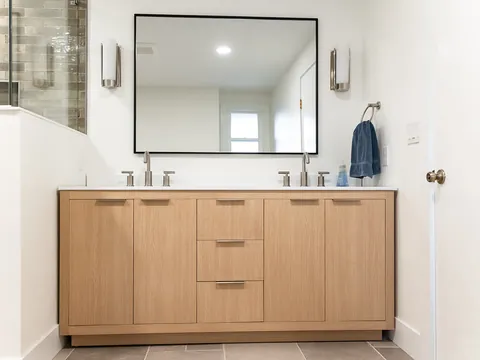
- A vanity with drawers rather than doors, ideally one drawer per person.
- Hooks instead of towel bars, at heights children can reach. Hooks dry towels well enough and get used.
- A recessed niche in the tub or shower wall for bottles, set where small hands can reach but out of the spray.
- A tall cabinet or linen tower if the room allows.
Two sinks help on school mornings if the room is wide enough; the NKBA guideline is 36 inches between sink centerlines. See bathroom storage.
Ventilation for a busy bath
Washington requires a fan ducted outdoors for every bathroom: 50 cfm intermittent or 20 cfm continuous, with a control the user can work. The Home Ventilating Institute recommends leaving the fan on for 20 minutes after using the bathroom, which rarely happens in a kids' bath unless the fan does it on its own. A timer or humidity-sensing control solves that. See bathroom exhaust fans.
Plan for children who grow
- Choose a standard-height vanity and use a sturdy step stool for now rather than a low vanity you will outgrow.
- Add a handheld shower on a slide bar. It rinses toddlers in the tub and adjusts for teenagers and adults.
- Ask for solid blocking in the walls around the tub and toilet so grab bars can be added later without opening the tile.
- Pick lever handles that small hands, and later older hands, can operate easily.
Budget and next steps
JDI's bathroom cost calculator gives these planning ranges for a full or hall bath with toilet, vanity and tub or shower, before sales tax: Essential $20,000-$32,000; Signature $32,000-$58,000; Luxury $58,000-$95,000. A full-bath Signature project typically runs 4 to 6 weeks on-site after design and permits. See bathroom remodel cost in Vancouver, WA for what changes the number, try the bathroom cost calculator, or start with bathroom remodeling in Vancouver, WA.
Common questions
Should a kids' bathroom have a tub or a shower?
With babies and young children, a tub is far easier for bathing. A tub with a shower over it serves the children now and teenagers later. If the hall bath is the only tub in the house, think hard before removing it, both for your own use and for future buyers.
How do I keep children from getting scalded in the shower?
Washington's plumbing code requires shower and tub-shower valves that protect against scalding and thermal shock, and limits shower water to 120°F. The valve's limit stop is set by the installer, and ASSE notes it can be set lower at the homeowner's preference. Tub fillers are also limited to 120°F. Ask that the limit stop be set and checked at the end of the job.
Is a glass shower door safe for kids?
Glass in shower and tub doors and enclosures must be safety glazing tested to the federal CPSC standard and permanently marked. That rule applies in every house. Some families still prefer a curtain rod while children are small, since it is easier to reach a child in the tub; a fixed glass panel is a middle ground.
What grout is easiest to keep clean?
Grout is a cement or resin product, and the denser and less absorbent it is, the easier it is to clean. Epoxy grouts meet ANSI A118.3 and high-performance cement grouts meet ANSI A118.7. Darker grout colors also hide the dirt that a family bathroom collects. Our grout and sealing page compares them.
- IAPMO: 2021 Uniform Plumbing Code (sections 408.3 and 409.4, scald protection)
- ASSE: Automatic compensating valves for showers and tub/shower combinations
- WAC 51-51-1505: Washington residential code, mechanical ventilation
- TCNA: Dynamic coefficient of friction FAQ
- TCNA: ANSI standards for tile installation
- Home Ventilating Institute: Bathroom ventilation
- Sherwin-Williams: Paint sheen guide
- City of Vancouver: 2025 Annual Water Quality Report
Checked October 2026. Rules, fees and programs change; confirm the current requirement with the agency before you rely on it.
Keep going
- JDI ConstructionBathroom remodeling in Vancouver, WAOur bathroom remodeling service, recent projects and what to expect.
- JDI ConstructionBathroom cost calculatorA 90-second estimate range for your bathroom, before you share any details.
- Exploring · Plan your bathroomPowder Room Remodels: Small Room, Big ImpressionPowder room remodels in Vancouver, WA: layout and clearances, wall-hung or floor vanities, bold finishes, lighting, the fan rule and JDI's planning ranges.
- Exploring · Plan your bathroomSmall Bathroom Remodel Ideas That Actually Add SpaceSmall bathroom remodel ideas that gain real space in a 5x8 or smaller bath, and which ones need plumbing, framing or electrical changes to build.