Bathroom Sinks: Undermount, Vessel, Integrated and Pedestal
By the JDI Construction teamReviewed by Arthur Kulchitskiy, Project Consultant, and Denise Lacquement, Designer (bathroom specialist)Updated October 20265 min read
An undermount sink is the easy-clean default for a stone or quartz vanity top. Drop-in sinks suit laminate and quick updates. Integrated sinks have no seam at all. Vessel sinks make a statement but raise the rim, splash more and need a tall faucet. Pedestal and wall-mount sinks save space and leave room for knees, but give up storage. Vitreous china is the common material.
The bathroom sink, called a lavatory in plumbing terms, is used more often than any other fixture in the room. The way it mounts decides how easy the counter is to clean, how much it splashes, which faucets work with it and whether the vanity can be used seated. This page covers the mounting types, the materials and the details to check. The cabinet and countertop are covered on bathroom vanities and vanity countertops.
Sink types compared
| Type | How it mounts | Cleaning | Splash | Works with | Relative cost |
|---|---|---|---|---|---|
| Undermount | Fastened beneath a stone, quartz or solid surface top | Easiest; wipe straight into the bowl | Low | Solid countertops; deck or wall faucets | Mid (plus top fabrication) |
| Drop-in (self-rimming) | Rim rests on the countertop | Rim edge collects grime | Low | Any countertop, including laminate | Lower |
| Integrated | Molded or fabricated as one piece with the top | Easiest; no seam | Low | Solid surface, cultured marble, some porcelain | Lower to mid |
| Vessel | Sits on top of the counter | More surfaces; joint at the base | Higher with shallow bowls | Tall deck faucets or wall-mount faucets | Lower to higher |
| Semi-recessed | Partly set into the counter, front edge overhanging | Moderate | Moderate | Shallow vanities | Mid |
| Pedestal | Basin on a column | Easy, but no counter | Low | Small rooms; traditional styles | Lower to mid |
| Wall-mount and console | Hung on the wall, sometimes with legs | Easy; open floor | Low | Powder rooms; accessible baths | Lower to higher |
Undermount, drop-in and integrated
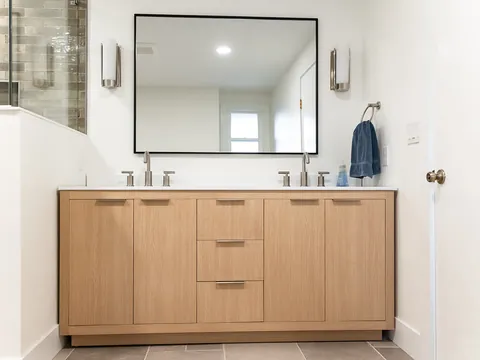
Undermount sinks are the common choice with a stone or quartz top. The counter's edge at the cutout is polished, and nothing stands up between the counter and the bowl, so you can wipe water straight in. The sink is clipped or bonded to the underside of the top, so the countertop has to be a solid material.
Drop-in sinks are set into a cutout from above, with the rim sealing on the counter. They work with any top, including laminate, and are easy to replace later. The rim and its caulk line collect toothpaste and grime.
Integrated sinks are made in one piece with the top, as in solid surface and cultured marble vanity tops. There is no joint at all, which makes them the easiest to clean. If the bowl cracks or is badly damaged, the top is usually replaced with it.
Vessel sinks
A vessel sink sits on the counter like a bowl. It suits modern and spa-style rooms and shows off stone, glass or ceramic. It also brings practical trade-offs:
- Height. The rim sits several inches above the counter. Pair it with a lower vanity, or it will be uncomfortably high. See vanity sizes and heights.
- Faucet. It needs a tall vessel faucet or a wall-mount faucet, with a spout that reaches over the rim to the center of the bowl.
- Splash. Shallow bowls splash. A deeper bowl and a soft aerated stream help.
- Drain. Many vessels have no overflow, so the drain must be the no-overflow type.
- Cleaning. The outside of the bowl and the joint at its base need wiping.
Pedestal, wall-mount and console sinks
These sinks give up storage for floor space. A pedestal sink suits a small powder room or a traditional bath. The column hides the trap but not much else, and there is no counter, so a shelf or medicine cabinet has to carry toiletries. Wall-mount sinks need solid blocking in the wall, and their plumbing is visible underneath unless a shroud or a neat chrome trap is used. Console sinks add legs and sometimes a towel bar or shelf.
Wall-mount sinks with open space beneath them are the most adaptable for seated use. The ADA's accessibility dimensions for knee space and sink height are a design reference for a private home, not a requirement. See aging-in-place bathrooms for how to apply them.
Sink materials
| Material | Strengths | Watch for | Standard |
|---|---|---|---|
| Vitreous china | Hard, glossy, stain resistant, easy to clean; the common choice | Can chip or crack from a dropped heavy object | ASME A112.19.2/CSA B45.1 |
| Enameled cast iron or steel | Durable gloss; heavy | Enamel chips | ASME A112.19.1/CSA B45.2 |
| Solid surface, cultured marble, other plastics | Integrated with the top; repairable | Scratches; heat and abrasives | CSA B45.5/IAPMO Z124 |
| Natural stone | Unique look; often vessel or carved | Acid-sensitive stones etch; needs sealing; no standard listing | None named |
| Glass | Striking in vessel form | Shows water spots and soap film | None named |
| Copper and other metals | Warm, changing patina | Patina changes with use; some cleaners strip it | None named |
A standard on the spec sheet does not make a sink better looking. It shows it was made and tested to an agreed baseline. Stone, glass and metal vessels sold as decor items may not name one.
Faucet compatibility
Choose the sink and faucet together. Three things must agree:
- Holes. Drop-in and some integrated sinks come with faucet holes already made, for a single-hole, a centerset or a widespread faucet. With undermount and vessel sinks, holes are drilled in the countertop, or the faucet comes out of the wall.
- Reach. The stream should land near the drain, not on the back wall of the bowl or over the front edge.
- Height. A tall faucet over a shallow bowl splashes. A short faucet cannot clear a vessel rim.
Faucet types and sizing are covered in bathroom faucets.
What to check before you buy
- Mounting type, and that it suits the countertop material.
- Bowl size and depth against the vanity and the faucet.
- Overflow or no overflow, and the matching drain.
- Faucet hole count and spacing, or a wall-mount plan.
- Total height with a vessel sink.
- Material and its cleaning needs; the standard on the spec sheet.
- For wall-mount and pedestal: wall blocking and where the drain and supplies come out.
- Drain finish matched to the faucet.
Who should choose which
- Most vanities with a stone or quartz top: an undermount vitreous china sink.
- Kids' baths and easy cleaning: an integrated sink, or an undermount with an overflow.
- Powder rooms and statement baths: a vessel or a wall-mount sink, accepting more wiping.
- Small rooms: a pedestal, wall-mount or semi-recessed sink on a shallow vanity. See small bathroom ideas.
- Seated users: a wall-mount sink with open knee space.
Replacing a sink can bring a plumbing permit into play in the City of Vancouver; see do you need a permit. JDI Construction confirms the sink, faucet and top together before fabrication. To plan yours, start with bathroom remodeling in Vancouver, WA.
Common questions
Does a bathroom sink need an overflow?
Not every sink has one, and many vessel and some designer sinks do not. The drain must then match: a sink without an overflow takes a drain made for no overflow, and a pop-up stopper may not be appropriate. Without an overflow, a forgotten running tap can spill onto the counter, so families with small children often prefer a sink that has one.
Are vessel sinks hard to keep clean?
They add surfaces. The outside of the bowl gets splashed and the joint where it meets the counter collects grime. Water also tends to splash out of shallow vessel bowls. A deeper bowl and a faucet with the right reach help.
Can I put an undermount sink in a laminate countertop?
Generally not with standard laminate, because the cut edge of the core is exposed to water. Laminate tops use drop-in sinks. If you want an undermount sink, choose a solid material such as quartz, granite, porcelain or solid surface.
Which sink is best for a wheelchair user?
A wall-mounted sink or a shallow sink in a counter with open knee space underneath, with the drain and supply lines insulated or covered so legs do not touch hot pipes. Pedestal sinks block the knee space. A lever or touch faucet within easy reach completes it.
- CSA Group: ASME A112.19.2/CSA B45.1, Ceramic Plumbing Fixtures
- ASME A112.19.1/CSA B45.2: Enamelled Cast Iron and Enamelled Steel Plumbing Fixtures
- ANSI blog: CSA B45.5/IAPMO Z124-2022, Plastic Plumbing Fixtures
- U.S. Access Board: 2010 ADA Standards for Accessible Design (a design reference for private homes)
Checked October 2026. Rules, fees and programs change; confirm the current requirement with the agency before you rely on it.
Keep going
- JDI ConstructionBathroom remodeling in Vancouver, WAOur bathroom remodeling service, recent projects and what to expect.
- Exploring · Vanities, toilets and fixtures in depthBathroom Faucets: Single-Hole, Widespread and Wall-MountChoosing a bathroom faucet: single-hole, centerset, widespread and wall-mount types, spout reach, cartridges, Washington's 1.2 gpm limit and finishes.
- Exploring · Vanities, toilets and fixtures in depthChoosing a Toilet: Flush Ratings, Heights, Shapes and Wall-Hung OptionsHow to choose a toilet in Vancouver, WA: Washington's 1.28 gallon flush limit, WaterSense and MaP testing, bowl height and shape, rough-in and wall-hung options.
- Exploring · Vanities, toilets and fixtures in depthBidets and Bidet Seats: Planning Power and WaterBidets and bidet seats for a Vancouver, WA bathroom: stand-alone, seat and integrated toilet options, the outlet beside the toilet, water supply and backflow.