How to Choose a Bathroom Remodeler in Vancouver, WA
By the JDI Construction teamReviewed by Arthur Kulchitskiy, Project Consultant, and Denise Lacquement, Designer (bathroom specialist)Updated October 20267 min read
Vet a bathroom remodeler in this order: confirm active Washington registration, bond and insurance in L&I's Verify tool; find out who will do the plumbing and electrical and check those credentials too; look at finished showers close up; ask exactly how the shower will be waterproofed; call references; then compare the written warranty and an itemized scope. Drop any company that fails the credential checks, whatever its price.
A bathroom packs more trades into less space than any other room: plumbing, electrical, ventilation, waterproofing, tile and glass, often within a few feet of each other. That makes it easy for a remodel to look finished and still be wrong behind the tile. Choosing a remodeler is mostly a process of elimination. Quick credential checks remove the companies you should not hire at any price, and slower checks tell you which of the rest fits your bathroom.
The vetting sequence at a glance
| Step | What you are checking | Where to check it |
|---|---|---|
| 1. Registration | Active Washington contractor registration, bond and insurance on file | L&I's Verify tool |
| 2. Trade credentials | Who does the plumbing and electrical, and whether they are certified | Ask, then look each one up in Verify |
| 3. Bathroom work | Finished showers and baths like yours, seen close up | Portfolio, then a visit or a call |
| 4. Waterproofing | The method and products used behind the tile | The first meeting and the written scope |
| 5. References | How the job ran, not only how it looks | Past clients and reviews |
| 6. Design and management | Who designs, who runs the job, how you hear about progress | The first meeting |
| 7. Warranty and scope | A written warranty and an itemized proposal | The estimate and draft contract |
Step 1: confirm registration, bond and insurance
Washington registers contractors; it does not test them. L&I says the state "does not require contractors to pass a competency or skills test to become registered", although it does test and license electricians and plumbers. Registration tells you a company is legal and has a bond and insurance on file. It does not tell you the company is good at showers. Under RCW 18.27.020 it is illegal to advertise, bid or work as a contractor without registering.
Search the company in L&I's Verify tool. The record shows whether the registration is active, the bond, the insurance policy, whether there is a paid-to-date workers' comp account for any employees, and any citations or lawsuits against the bond. A remodel that uses several trades on one job is general contractor work under RCW 18.27.010; as of October 2026 a general contractor's bond is $30,000 (RCW 18.27.040). Our page on checking contractor, plumber and electrician credentials walks through the lookup field by field.
Step 2: find out who does the plumbing and electrical
This is the check most homeowners skip, and it matters more in a bathroom than anywhere else. RCW 18.106.020 says no one may engage in the trade of plumbing without a certificate, and L&I puts it plainly: "Only L&I-certified plumbers can legally perform plumbing work on someone else's property." Plumbing work for you must be done by an L&I-licensed plumbing contractor using certified plumbers. Electrical work is licensed separately under chapter 19.28 RCW, which requires an electrical contractor license to advertise, bid or do the work.
Ask every candidate two direct questions: which licensed plumbing contractor and which electrical contractor will work on your bathroom, and what their license numbers are. Then look them up in the same Verify tool, which also confirms whether an individual plumber or electrician is certified. L&I also says a plumber's certification ID must be visibly displayed on the job. A vague answer here ("our guy handles that") is a reason to keep looking.
Step 3: look at bathrooms, close up
A wide photo tells you little. The skill shows in details a camera at the doorway misses. When you look at a portfolio or visit a finished job, look for:
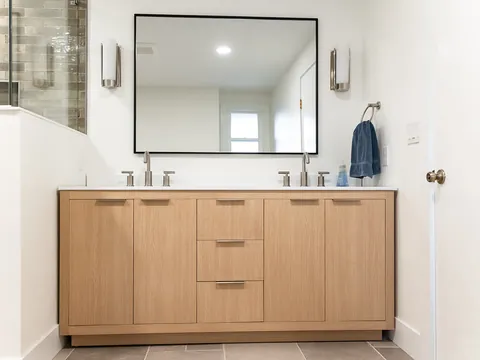
- Tile layout. Cuts at the edges should be balanced, not a sliver on one side. Grout lines should run through niches and benches without jogging.
- Niche and bench edges. Clean, square corners and finished edges, with the niche sized to the tile so it needs no thin cuts.
- Shower floor. Even slope to the drain with no low spots where water sits.
- Glass. Even gaps and a door that closes without rubbing.
- Transitions. Where tile meets drywall, tub, vanity or flooring.
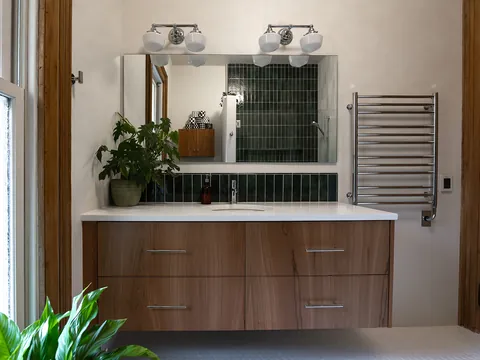
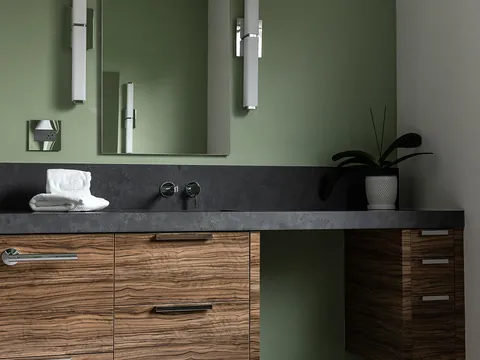
Match the scope too. A tub-to-shower conversion, a curbless shower and a primary suite with a freestanding tub are different jobs. Ask to see work at your level. JDI's bathroom project gallery is an example of what to ask any company for: finished rooms shown closely enough to judge.
Step 4: ask how the shower will be waterproofed
Tile and grout are not waterproof. Whatever keeps water out of the wall and floor sits behind them, and once the tile is up you cannot inspect it. So ask each remodeler to name the method: a traditional mortar bed over a shower-pan liner, a bonded sheet membrane, a liquid-applied membrane, or a foam board system. A good answer is specific and consistent with the written scope. If the answer changes between the meeting and the proposal, ask why.
Two standards are worth knowing by name. ANSI A118.10 covers bonded waterproof membranes for tile, and the Tile Council of North America (TCNA) describes shower methods such as B415 (mortar bed over a shower-pan membrane) and B421 (bonded waterproof membrane). TCNA also advises specifying installers certified in membrane installation when a sheet or liquid membrane is used. Ask whether the installer holds that certification; it is not legally required, but it is a useful sign. Our page on shower waterproofing explains each system.
Step 5: use references for what photos cannot show
Photos show the result. References tell you how the weeks in between went. Ask each past client the same questions so the answers compare:
- Did the final price match the contract, and were changes written up and priced before the work?
- How long were you without the bathroom, and did that match what you were told?
- How was dust controlled, and was the house cleaned up each day?
- Has anything leaked, cracked or needed fixing since, and did the company come back?
Read reviews from bathroom clients the same way. A detailed account of a problem handled well tells you more than a row of ratings with no text.
Step 6: find out who designs and who manages
Someone has to turn your wish list into dimensions: where the drain goes, how big the niche is, what the glass will clear. Ask who that person is and what you will see before you sign, such as a floor plan, a 3D view and a selections list. Then ask who runs the job day to day, how often they are on site, and how you get updates. Whether design sits inside the building company or with a separate designer changes who answers when a drawing and a wall disagree; see design-build vs hiring a designer and contractor separately.
Step 7: read the warranty and the written scope
A workmanship warranty should be written, state its length, and say how to make a claim. Ask specifically whether it covers leaks from the shower and the waterproofing, since that is the failure that costs most to fix. Product warranties on valves, fixtures and glass come from the makers and are separate; see bathroom remodel warranties.
The scope is the other half. L&I recommends a written contract that states the price including sales tax, the specific work, the materials, and the warranty and change order process. When two finalists are close, compare their estimates line by line and bring the questions to ask a bathroom contractor to the meeting.
How JDI fits these checks
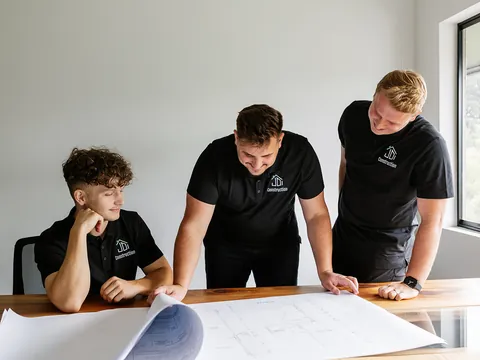
Run the same checks on us. JDI Construction holds Washington contractor registration #JDICOCN932KZ and Oregon CCB #176101; confirm the bond, insurance and workers' comp status in Verify yourself, and ask us who will do the plumbing and electrical on your job and look them up too. We are family-owned, operating since 2007, from 1419 Broadway Street in Vancouver. As a design-build firm, design and construction come from one accountable team: Denise Lacquement, our bathroom designer, plans the layout and selections and works with the project managers through construction. We handle permits, give updates through a client portal, and back our work with a written 5-year workmanship warranty. Start with our bathroom remodeling service in Vancouver, or request a free in-home consultation and put these questions to us directly.
Common questions
Is a tile setter enough for a shower remodel?
Only for the tile itself. A shower remodel usually also involves a new valve, drain or supply lines, and L&I says only certified plumbers can legally do plumbing work on someone else's property. Washington's tile specialty registration notes that the work may also require plumber certification or an electrical license. Ask who handles each part before you compare prices.
My house was built before 1978. Does that change who I can hire?
Yes. Washington's lead rules require renovations done for pay in pre-1978 homes to be performed by certified firms using certified renovators, unless the affected surfaces have been tested and found free of lead-based paint. Tearing out painted bathroom walls counts as demolition of painted surfaces. Ask for the firm's Department of Commerce certificate and expect the Renovate Right pamphlet before work starts.
Can an Oregon contractor remodel my bathroom in Vancouver, WA?
Only if the company is also registered in Washington. RCW 18.27.020 makes it illegal to advertise, bid or work as a contractor here without Washington registration, so an Oregon CCB number on its own is not enough. Look the company up in L&I's Verify tool.
Is a very long warranty a good sign?
Not by itself. L&I lists a contractor who offers exceptionally long warranties among its warning signs, because a warranty is only as good as the company's ability to be there to honor it. Read what the warranty covers, especially leaks and waterproofing, and check how long the company has been registered.
How many remodelers should I talk to?
Enough to compare at least two complete, written proposals for the same scope. Fewer than that gives you nothing to measure against; many more tends to blur the details. The credential checks below are quick, so run them before you spend time on a site visit.
- Washington L&I: Verify a Contractor, Tradesperson or Business
- Washington L&I: Hire Smart, step by step
- RCW 18.27.040: Contractor bond amounts
- RCW 18.106.020: Plumbing certificate required
- Washington L&I: Plumbing
- RCW 19.28.041: Electrical contractor license
- TCNA: 2026 Tile Initiative (installer certification)
- Washington Department of Commerce: Lead-Based Paint Program
Checked October 2026. Rules, fees and programs change; confirm the current requirement with the agency before you rely on it.
What bathroom clients say
While this remodel, like every remodel had its share of bumps, the team handled each issue as it arose. They were great to work with and we are thrilled with the way our bathroom turned out.
Catherine B. · Google review, Mar 18, 2026
Friendly staff and good service! Very efficient and reliable. This company is really top-notch when it comes to remodeling services. We just had our bathroom renovated and I thought they did just great. Two thumbs up for JDI.
Carole B. · Google review, Dec 5, 2025
Had JDI come out for a bathroom remodel in my home in Tualatin. They were on time, gave a great design, and got the work done within the given time frame. They were competitively priced and did amazing work. I highly recommend them and will be using them for my addition this summer!
Nathan P. · Google review, Jan 10, 2026
Keep going
- JDI ConstructionBathroom remodeling in Vancouver, WAOur bathroom remodeling service, recent projects and what to expect.
- JDI ConstructionBathroom remodeling reviewsWhat homeowners say about their JDI bathrooms.
- JDI ConstructionBathroom projectsBefore-and-after bathrooms we have completed around Vancouver and Portland.
- Ready to hire · Hiring and getting startedDesign-Build vs Hiring a Designer and Contractor Separately for a BathroomDesign-build or a separate designer and contractor for a bathroom: who owns waterproofing and selections, how scheduling and pricing differ, and which fits.