How to Save on a Bathroom Remodel Without Regretting It
By the JDI Construction teamReviewed by Arthur Kulchitskiy, Project Consultant, and Denise Lacquement, Designer (bathroom specialist)Updated October 20265 min read
The safest savings on a bathroom remodel come from keeping the toilet, vanity and shower drain where they are, choosing a stock vanity, using porcelain or ceramic tile in simple layouts, and picking standard shower glass. Do not save on waterproofing, the shower valve, the exhaust fan or a sound subfloor. Making every selection before demolition prevents change orders, which cost more than the same decision made on paper.
Saving money on a bathroom is mostly about choosing which decisions to spend on. Some cuts are invisible in a year and harmless in ten. Others are invisible on the day the tile goes up and very expensive when the shower starts leaking into the ceiling below. This page sorts the two, then covers phasing and the habit that saves more than any material choice: deciding early.
Start from a realistic range
Before trimming anything, know where you are. JDI Construction's published planning ranges for a full or hall bath are $20,000-$32,000 at the Essential tier, $32,000-$58,000 at Signature and $58,000-$95,000 at Luxury, before sales tax. A half bath or powder room starts at $9,000-$16,000. The full tables are on bathroom remodel cost in Vancouver, and the bathroom cost calculator gives a range for your room. If your budget sits at the bottom of a tier, the cuts below are how you stay there.
Where to save
| Decision | Lower-cost choice | Why it is safe |
|---|---|---|
| Layout | Keep the toilet, vanity and shower drain where they are | No floor opening, rerouting or extra rough inspections |
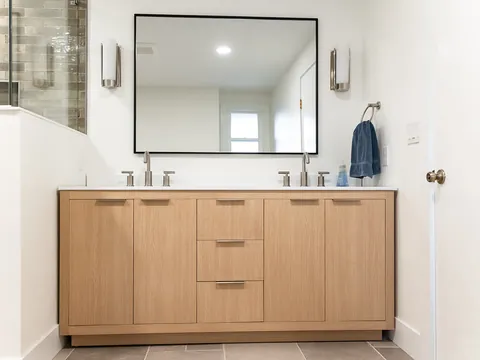
| Vanity | Stock or semi-custom in a standard width | Easy to replace later; does not affect what is behind the wall |
| Wall tile | Porcelain or ceramic in a simple layout | Durable; fewer cuts than patterns or mosaics |
| Shower size | Standard dimensions that fit the existing footprint | Less tile, membrane and glass |
| Glass | One fixed panel or a standard framed door | Less glass and hardware than a full enclosure |
| Tub | Keep a sound existing tub | Removes a heavy item from demolition and the budget |
| Accent features | One feature wall or niche instead of several | Pattern and inlay labor is priced as an add-on |
Keep the layout
This is the single largest saving available. Moving a drain means cutting into the floor, routing it at the right slope and vent, and inspection before anything is covered. If the current layout works, spend the money on the finishes instead. If it does not, see bathroom layouts for changes that move as little plumbing as possible.
Choose where tile labor goes
Tile material is only part of the cost; the hours to set it are the rest. Larger tile on flat walls means fewer pieces and fewer cuts. Small mosaics belong on the shower floor, where they follow the slope to the drain, rather than on every wall. A custom pattern or inlay is a $3,000-$9,000 add-on in JDI's calculator, so pick one spot for it if you want one.
Mix price levels
A stock vanity with a good faucet, or simple wall tile with a statement floor, often looks better than a room where every item is mid-range. Spend on what you touch and see daily, and save on what you look past.
Where not to save
These are the items that are cheap to do right while the room is open and expensive to fix after it is finished.
- Waterproofing. Tile and grout are not waterproof. The Tile Council of North America says that with bonded-membrane shower methods the membrane must cover the solid backing under the entire area to be tiled. A shortcut here means tearing out the finished shower later. See waterproofing explained.
- The shower valve. The Uniform Plumbing Code (408.3) requires a pressure-balance, thermostatic or combination valve. Buy a valve body from a line with parts you can still get, because replacing it means opening tiled wall.
- The exhaust fan and duct. Washington's residential code (WAC 51-51-1505) requires bathroom exhaust of at least 50 cfm intermittent or 20 cfm continuous, ducted directly to the outside. A quiet fan gets used; a loud one gets switched off. See bathroom exhaust fans.
- The subfloor. Tile on a floor that flexes cracks. If demolition shows soft or water-damaged subfloor, replacing it is not optional.
- Blocking. Wood blocking for future grab bars, a glass door or a heavy mirror costs little while studs are bare. Adding it later means opening finished tile.
Decide before demolition
A change made after tile is ordered or walls are closed costs more than the same decision made on paper, and it stops the schedule while new material arrives. The Washington Department of Labor & Industries advises getting any change in writing and avoiding verbal amendments. The cheapest way to avoid change orders is to finish every selection first:
- Layout and sizes: shower size, vanity width, toilet position, door swing.
- Inside-the-wall items: valve type and position, niche and bench locations, blocking, lighting and outlet locations, fan location.
- Long-lead items: vanity, tile, tub and any special-order fixture.
- Finishes: grout color, paint, hardware, mirror, accessories.
Make the first two before demolition and the third before ordering. Glass is measured after tile is finished, so it is the one item that naturally comes last. The bathroom remodel checklist lists every decision in order.
Phasing a bathroom
If the budget will not stretch to everything now, phase by layer, not by room surface. Everything inside the walls and floor belongs in one phase: plumbing, wiring, the fan and duct, waterproofing and tile. Items that can be swapped later without opening anything, such as light fixtures, the mirror, towel bars or even the vanity top, can wait. Doing the shower this year and the floor next year usually means demolishing the new work at the edges and paying twice for setup.
In a house with more than one bathroom, finishing one before starting the next keeps a working shower in the house. Living through a bathroom remodel covers that sequence.
Small savings that add up
- Donate what comes out. Evergreen Habitat for Humanity's Habitat Stores accept, at staff discretion, clean low-flow toilets, used sinks, standalone vanities, shower doors and framed mirrors, and offer residential pick-ups.
- Use allowances honestly. If an estimate carries an allowance for tile or fixtures, choose within it, or know the difference you will pay.
- Look at incentives. Most bathroom fixtures have no rebate here, but a heat pump water heater can. See rebates and water savings.
For more ideas, the JDI blog post on remodeling a bathroom on a budget covers cosmetic updates. When you want a figure for your own bathroom, JDI Construction provides an itemized plan after a free in-home consultation, so you can see exactly which lines to trim. Request a consultation or read about bathroom remodeling in Vancouver.
Common questions
Is it cheaper to remodel two bathrooms at once?
Often the combined job is more efficient than two separate ones, because demolition, trade visits, inspections and selections can be shared. The trade-off is that both rooms are out of service at the same time. In a house with only two bathrooms, doing them one after the other keeps one shower working throughout.
Can I keep my existing tub to save money?
If the tub is sound, the right size and in a finish you can live with, keeping it removes a heavy, awkward item from demolition and the budget. Protect it during the work, and plan the new wall tile around it. The tub-or-no-tub page covers whether a tub still earns its space.
Does a low-flow toilet or showerhead save money on the remodel itself?
Not on the remodel, because Washington's plumbing code already requires new toilets to flush at 1.28 gallons or less and showerheads to flow at 1.8 gallons per minute or less. The saving is on your water bill over time. The rebates page lists what incentives exist as of October 2026.
What is a reasonable way to phase a bathroom remodel?
Do the work inside the walls and floor in one phase: plumbing, wiring, the fan and its duct, waterproofing and tile. Items that can be swapped later without opening anything, such as a mirror, light fixtures or accessories, can wait. Phasing the shower and the floor separately usually costs more.
- WAC 51-56-0400: Washington amendments to the Uniform Plumbing Code (flow rates)
- WAC 51-51-1505: Washington residential code, bathroom exhaust
- TCNA: Showers FAQ
- IAPMO: 2021 Uniform Plumbing Code (section 408.3, shower valves)
- Washington Department of Labor and Industries: Hire smart, step by step
- Evergreen Habitat for Humanity: Habitat Stores
Checked October 2026. Rules, fees and programs change; confirm the current requirement with the agency before you rely on it.
Keep going
- JDI ConstructionBathroom cost calculatorA 90-second estimate range for your bathroom, before you share any details.
- Planning · Budget and timingFinancing a Bathroom Remodel: Cash, HELOC, Loans and Contractor FinancingHow to pay for a bathroom remodel in Vancouver, WA: cash, HELOC, home equity loan, cash-out refinance, personal loans, FHA 203(k) and contractor financing.
- Planning · Budget and timingRebates, WaterSense and Water Savings for a Bathroom RemodelBathroom rebates and water savings in Vancouver, WA as of October 2026: WaterSense fixtures, Washington flow limits, utility offers and the ended 25C credit.
- Planning · Budget and timingDoes a Bathroom Remodel Add Value? Resale in the Vancouver AreaDoes a bathroom remodel add value near Vancouver, WA? Cost vs. Value 2025 Pacific region percentages, Seattle and Portland figures, and property tax.